
🇲🇦 Morocco Itinerary – The Perfect 7, 10 , 14 Days
By Kamal, Official Moroccan Tour Guide from Tinghir
Planning a trip and not sure how to organize your time? This Morocco itinerary 7, 10 & 14 days is designed by a local Moroccan tour guide to help you experience the real Morocco from Marrakech and the Atlas Mountains to the Sahara Desert, Fes, Chefchaouen, and the Atlantic coast, with realistic routes, travel times, and insider tips.
Morocco is not a country you rush through. It’s a country you enter slowly. You feel it first in the air, then in the voices of the medina, then in the silence of the desert. I was born in Tinghir, between the High Atlas Mountains and the Sahara, and these roads have been part of my life since I was a child. Today, I guide travelers across my country, and this itinerary is exactly how I show Morocco to my guests when they ask me, “Kamal, if I only have one trip, how should I do it?”
What you read here is not from books. It’s from years on the road tea stops, long drives, wrong turns, sunrise in the dunes, and late dinners in quiet riads.
Whether you have 7 days, 10 days, or 14 days, this journey is designed to flow naturally. You don’t change routes you simply go deeper.
Before diving into the route, you can also explore my main hub Morocco Travel Guide and the planning page Plan Your Trip to Morocco for transport, seasons, safety, and practical tips.
Morocco itinerary 7, 10 & 14 days Route
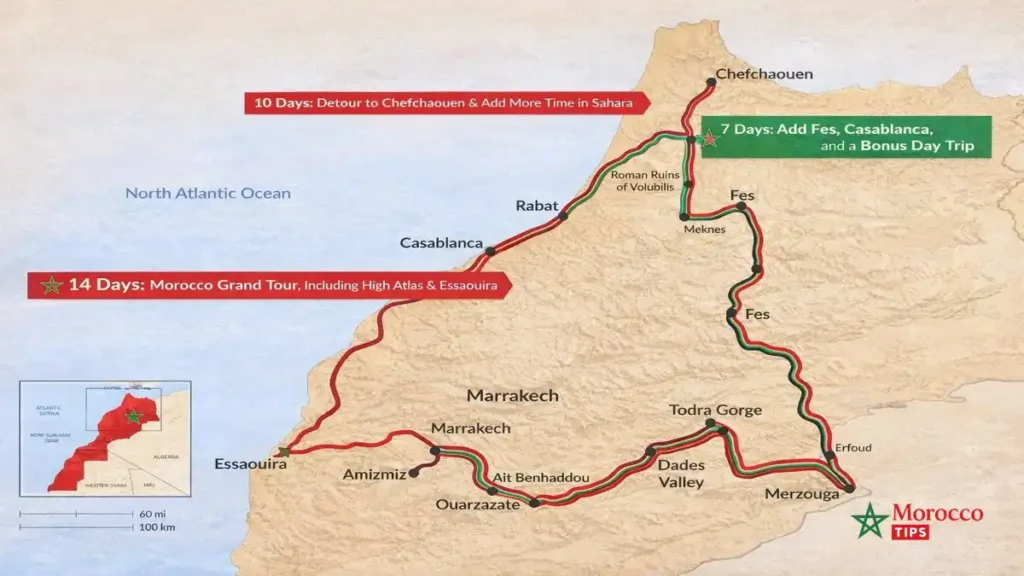
This route map gives you a quick overview of the best way to travel around Morocco without backtracking too much. I built it like a local guide starting with the big highlights (Marrakech, Fes, Chefchaouen), then adding the Sahara Desert (Merzouga) and scenic stops like Aït Ben Haddou and the Dades Valley. Now let’s jump into the exact day-by-day plan so you can copy it for your trip.
7 Days in Morocco – A First Love with the Country
Day 1 – Arrival in Marrakech
From the airport to your riad inside the medina usually takes 20 to 45 minutes, depending on traffic and how deep your riad is in the old city. The moment you leave the main road and enter the small streets, everything changes. Cars disappear. You hear scooters, voices, metal doors closing, the smell of bread and spices.
Drop your bags and go out. Don’t wait.
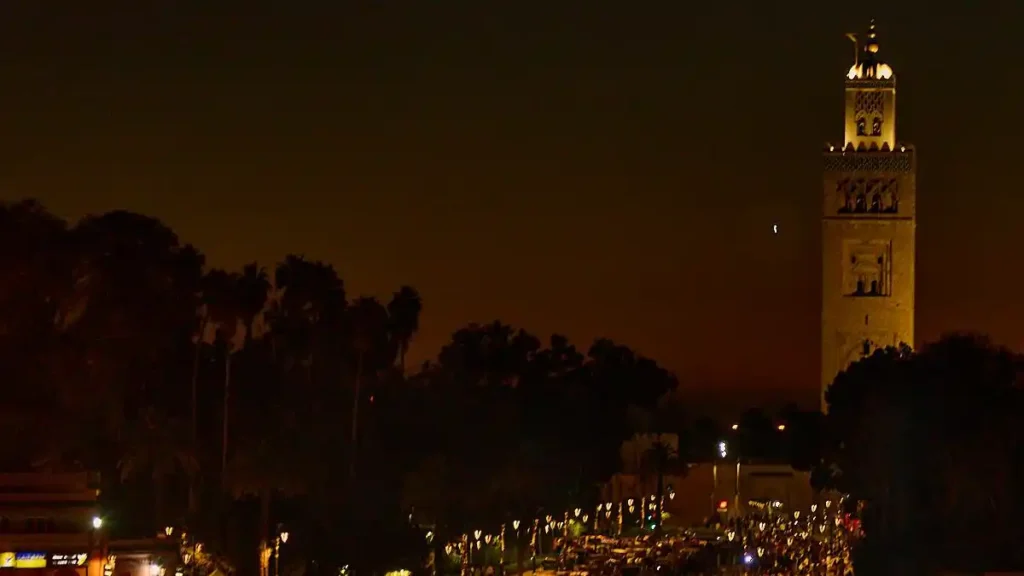
Let yourself walk without a plan until you reach Jemaa el-Fna. Come here at sunset. During the day it looks empty. At sunset it wakes up food stalls, drums, storytellers, smoke rising, and people from everywhere. I always tell my guests to sit on a rooftop, order mint tea, and just watch for five minutes without touching the phone. That moment is Morocco saying welcome.
Eat something simple tonight a tajine, grilled meat, bread. Sleep early. Tomorrow, the city opens.
If you want a deeper look at palaces, souks, food spots, and local experiences, I’ve shared everything in my full guide Things to Do in Marrakech.
Day 2 – Marrakech, deep inside the medina
This is a walking day, usually 4 to 6 hours on foot. Start around 9:00 am, when the light is soft and the streets are calmer. Visit old places like Ben Youssef Madrasa and Bahia Palace, then dive into the souks. Not to rush. Not to buy fast. To watch. A man shaping brass with a hammer. Another cutting leather. A woman choosing spices for lunch. This is not tourism for them it’s life.
Around midday, Marrakech becomes heavy. Heat, noise, crowds. This is when locals slow down. Lunch inside a riad. Rest. Maybe a hammam. Then, in the late afternoon, you go out again. Different light. Different feeling. At night, Jemaa el-Fna is alive again, but never in the same way as the night before.
Day 3 – Marrakech to the Atlas Mountains and Dades Valley
Leave Marrakech around 8:00 am. Today you drive about 6.5 to 7.5 hours including stops. The road climbs into the High Atlas Mountains through the Tizi n’Tichka pass. The air cools. Views open. Villages appear that look like they grew from the rock itself.
For me, these mountains are personal. Some of my family live in villages like these. Every tea stop reminds me that in Morocco, you don’t just drive you sit, drink, talk, and look.
By midday, you reach Ait Ben Haddou, the ancient ksar once used by caravan traders crossing the Sahara. Walk through its alleys, climb to the top, and imagine camels arriving with salt and gold. After lunch, continue south through Ouarzazate and into the Dades Valley, where red cliffs glow at sunset.
Dinner is usually homemade here. Quiet night. You feel far from everything.
Day 4 – Dades Valley to Merzouga, Entering the Sahara
After breakfast, drive about 4.5 to 5.5 hours toward the desert. Stop at Todra Gorge to walk between cliffs that rise straight into the sky. Then the landscape opens. Palm oases appear. Villages become smaller. The desert comes closer.
By mid-afternoon, you reach Merzouga. Rest. Drink tea. Then ride camels into the dunes. The walk is slow. The world becomes quiet. At sunset, the sand turns gold, and even people who talk all day suddenly stop.
At the camp, you climb a dune, watch the last light, then enjoy dinner, drums, and stories under a sky full of stars. Even after so many times, this moment still touches me.
For camel trekking, quad biking, village visits, and desert camp tips, see my local Merzouga guide.
Day 5 – Sahara to Fes, the Long Road North
Wake up before dawn for sunrise in the dunes. Cold air. Silence. Soft gold light. This is one of Morocco’s greatest gifts.
After breakfast, start the long drive north about 8.5 to 10 hours on the road. You pass through the Ziz Valley, where thousands of palm trees grow along a green ribbon. Stop for photos. Lunch in Midelt. Then cross the Middle Atlas Mountains, with cedar forests and sometimes monkeys on the road.
This is a long day, but one of my favorites. On these roads, I’ve shared music, laughter, and deep talks with people who arrived as guests and left as friends.
By evening, you reach Fes. Simple dinner. Sleep well.
Day 6 – Fes, Walking Inside History
Fes is not like Marrakech. Marrakech is energy. Fes is depth.
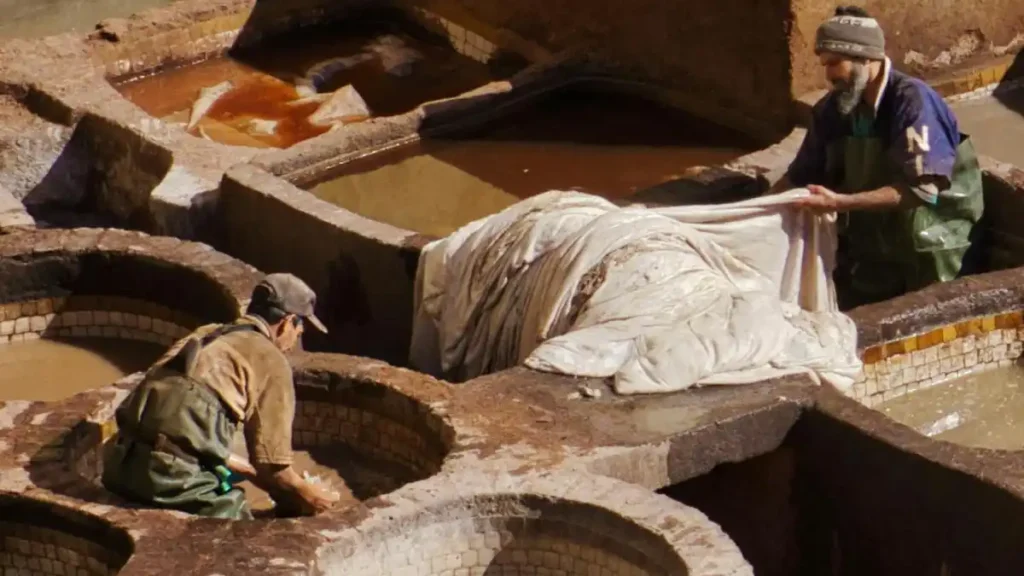
This is a walking day, usually 4 to 6 hours on foot. The medina is a living maze narrow alleys, donkeys carrying goods, hidden workshops, madrasas shining with carved plaster. With a local guide, you explore tanneries, old schools, and rooftops that look over thousands of houses.
The first time I brought a guest here, he stopped and said, “Kamal, this feels like walking inside history.” I never forgot that.
Evening in Fes is calm. Perfect for reflection.
I’ve detailed the medina routes, madrasas, tanneries, and viewpoints in my Fes travel guide, which will help you plan your walking day.
Day 7 – End of the 7-Day Journey (or… Continue)
After breakfast, you can leave Morocco from Fes, or transfer to Casablanca. The drive to the airport takes 30–40 minutes; to Casablanca about 3.5 to 4.5 hours.
If you only have 7 days, your journey ends here and you’ve already seen mountains, desert, and two great cities.
But if you have more time, this is where Morocco opens even more.
For the best blue streets, viewpoints, cafés, and photo spots, explore Chefchaouen travel guide.
Extending to 10 Days – The Best Balance
With 10 days, you don’t rush home. You go north into the mountains and touch the Atlantic.
Day 7 – Fes to Meknes, Volubilis & Chefchaouen
Leave Fes in the morning. Today’s drive is about 5 to 6 hours including stops. First, a short stop in Meknes, another imperial city, calmer and elegant. Then continue to Volubilis, where Roman columns stand quietly among olive fields a reminder that Morocco has been a crossroads of civilizations for thousands of years.
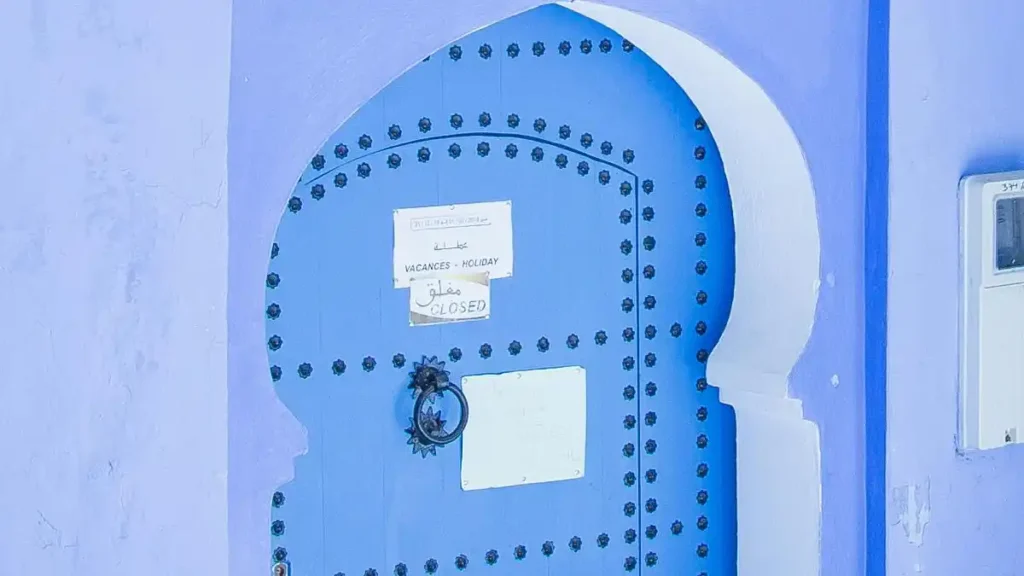
In the afternoon, climb into the Rif Mountains toward Chefchaouen. When the blue walls appear, everything slows down. Check into your riad and walk through blue alleys where cats sleep on doorsteps and kids play football in tiny squares. Sunset from above town is always special.
Day 8 – Chefchaouen, the Art of Doing Nothing
This is a slow day. Walking only, about 2 to 4 hours in total.
Wake up without an alarm. Open your window to mountain air. Wander blue streets while shops open. Sit in cafés. Visit the kasbah garden. I always tell my guests: today, don’t ask “what’s next?”. Just be.
Before sunset, walk again through your favorite streets or up to the Spanish Mosque. Light changes everything here.
Day 9 – Chefchaouen to Rabat and Casablanca
Leave around 8:00 am. Today you drive about 5.5 to 6.5 hours including your stop in Rabat. Walk the Kasbah of the Udayas, overlooking the Atlantic, and see the Hassan Tower. Rabat feels calm and organized after intense medinas.
After lunch, continue to Casablanca. Check in, maybe walk along the Corniche, and rest.
Day 10 – Casablanca, Last Moments
If your flight is later, visit the Hassan II Mosque, standing partly over the ocean. Then enjoy a final coffee and head to the airport. The transfer usually takes 45 to 60 minutes.
Ten days gives you a complete picture: cities, desert, mountains, and sea.
If you have time in the city, my guide Casablanca shows you the mosque visit, Corniche walks, and local food spots.
14 Days in Morocco – Morocco Like We Live It
With 14 days, Morocco becomes more than a trip. It becomes a connection.
Instead of flying home from Casablanca, you go north then slowly return south along the coast.
Day 11 – Casablanca to Tangier
Travel to Tangier by high-speed train (2 to 2.5 hours) or by road (3.5 to 4 hours). Tangier feels different sea air, open views, and a sense of being at the edge of Africa. Walk in the kasbah, sit in a café facing the Strait of Gibraltar. On clear days, you see Spain.
For the best viewpoints, kasbah walks, cafés, and seaside spots, explore my local guide Tangier.
Day 12 – Tangier, Cape Spartel & Asilah
Drive about 2 to 3 hours total today. Visit Cape Spartel, where the Atlantic meets the Mediterranean, and the legendary Hercules Caves. Then continue to Asilah, a small white town with murals and quiet streets. Lunch by the ocean, walk the ramparts, and return to Tangier in the evening.
Day 13 – Tangier to Essaouira, the Long Way Back South
Start early. Today is a long road, about 7 to 9 hours of driving. Many guests stop near Marrakech for lunch, then continue west to Essaouira.
When you arrive, everything changes again. Wind on your face. Seagulls crying. Waves crashing against old ramparts. Essaouira is where Morocco exhales.
Walk to the port, choose fresh fish, have it grilled on the spot. Simple. Perfect.
I’ve shared my favorite spots, cafés, seafood places, and walks in my Essaouira travel guide, so you can enjoy the city at your own pace.
Day 14 – Essaouira to Marrakech, Closing the Circle
After breakfast, a last walk through Essaouira’s medina, then drive back to Marrakech in about 2.5 to 3.5 hours for your flight home.
Ending where you started feels right. It closes the story
🧡 From Me to You
Morocco is not only what you see it’s what you feel. Leave space for tea with strangers. Leave space for silence in the Sahara. Leave space for getting lost in a medina.
That’s when Morocco gives you the best of itself.
🇲🇦🤍
Kamal
❓ Frequently Asked Questions About Visiting Morocco
Is 7 days enough to see Morocco?
Seven days is enough to see Morocco’s highlights if you focus on the classic route: Marrakech, the Atlas Mountains, the Sahara Desert, and Fes. It’s fast, but powerful. If it’s your first time and you only have one week, this itinerary gives you a strong first taste of the country.
Is 10 days better than 7 days in Morocco?
Yes. With 10 days, you travel at a more relaxed pace and add Chefchaouen, Rabat, and Casablanca to your journey. You still experience the desert and imperial cities, but you also get quiet mountain towns and Atlantic views. This is the option I recommend most to my guests.
What can I see in Morocco in 14 days?
With 14 days, you can explore Morocco from north to south: Marrakech, the Sahara, Fes, Chefchaouen, Rabat, Casablanca, Tangier, Asilah, and Essaouira. Two weeks allows you to slow down, enjoy coastal towns, and really understand the country’s diversity.
What is the best route for a Morocco itinerary?
The best route for most travelers starts in Marrakech, goes through the Atlas Mountains to the Sahara Desert, continues to Fes, then north to Chefchaouen, and finishes on the Atlantic coast before returning to Marrakech or Casablanca. This loop avoids backtracking and shows you Morocco’s changing landscapes.
How much driving is there in a Morocco itinerary?
Morocco is a large country, and some days involve long drives, especially between the Sahara and Fes (8–10 hours). But these drives are part of the experience, with stops in valleys, mountains, and villages. I always plan realistic times so travelers don’t feel rushed.
Is it safe to travel around Morocco?
Yes, Morocco is generally very safe for travelers. Like anywhere, you should stay aware in busy areas, but violent crime is rare. Traveling with a local guide or driver makes the journey even smoother and helps you avoid tourist hassles.
How many days do I need for a good trip?
To enjoy Morocco properly, I recommend 7 to 10 days.
With this time you can visit cities, the Sahara, mountains, and coast.
Short trips like 3 or 5 days are also possible just choose one region.
When is the best time to follow this Morocco itinerary?
The best time to visit Morocco is in spring (March–May) and autumn (September–November) when temperatures are pleasant across cities, mountains, and the desert. Summer can be very hot in Marrakech and the Sahara, while winter is cold at night in the desert and mountains.
Do I need a guide for this itinerary?
You can travel independently, but having a local guide or driver makes a big difference. You save time, avoid getting lost, learn the stories behind places, and enjoy local connections that most travelers never see.
What kind of accommodation is best in Morocco?
I always recommend staying in riads inside medinas for cities and a desert camp in Merzouga. Riads give you a real Moroccan atmosphere, and desert camps let you experience the Sahara under the stars.
Can I customize this Morocco itinerary?
Absolutely. Every traveler is different. This itinerary is a base that can be adapted depending on your interests culture, food, photography, hiking, luxury, or family travel.