
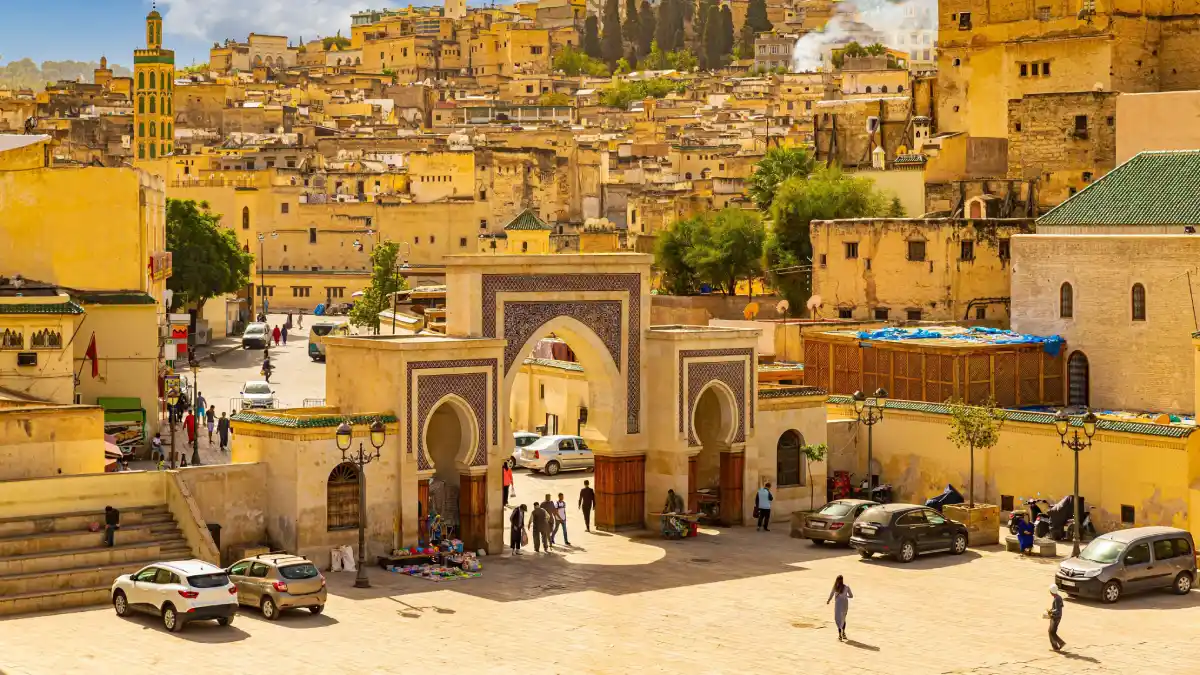
Planning a Morocco itinerary usually starts with the same question: how many days do I actually need?
Seven days, 10 days and 14 days can all make excellent trips, but they are not simply shorter or longer versions of the same holiday. The pace changes. The amount of driving changes. And most importantly, the places you can enjoy properly change.
I’m Kamal, a licensed Moroccan tour guide based in Marrakech. I have been guiding travelers around Morocco for many years, from the old medinas and High Atlas Mountains to the Sahara Desert, Fes, Chefchaouen and the Atlantic coast.
One of the most common mistakes I see is trying to fit every famous place into the number of days available.
Morocco does not work very well that way.
Marrakech, the Sahara, Fes, Chefchaouen and Essaouira may all look manageable when you see them on a map, but there are mountains, long roads and big distances between them.
My advice is simple: choose the trip that fits your time instead of forcing Morocco to fit your checklist.
If you already know exactly how long you are staying, you can jump directly to my detailed itineraries: If your trip is shorter than one week, see my Morocco itinerary for 5 days for three routes designed around realistic driving times.
If you are still deciding, this guide will help you choose.
Table of Contents
Table of Contents
Quick Answer: Should You Spend 7, 10 or 14 Days in Morocco?
For most first-time visitors, I recommend 10 days in Morocco if your schedule allows it.
Seven days is enough for a focused first journey that combines Marrakech, the High Atlas Mountains, the Sahara Desert and Fes, but you need to accept some long travel days.
Ten days gives you more breathing room. You can spend more time in Marrakech and the desert, explore Fes properly and continue north to Chefchaouen.
Fourteen days changes the rhythm completely. You can add places such as Meknes, Volubilis, Rabat, Casablanca and Essaouira while still having slower days between the major travel sections.
| Trip Length | Best For | Pace | Main Experiences |
|---|---|---|---|
| 7 days | First-time visitors with limited time | Fast | Marrakech, Atlas Mountains, Sahara, Fes |
| 10 days | Most first-time visitors | Balanced | Marrakech, Atlas Mountains, Sahara, Fes, Chefchaouen |
| 14 days | Travelers who want a fuller Morocco experience | More relaxed | Marrakech, Sahara, Fes, Chefchaouen, imperial cities, Atlantic coast |
My personal choice for most travelers? 10 days.
It gives you enough variety to understand Morocco without turning every morning into another checkout and another long drive.
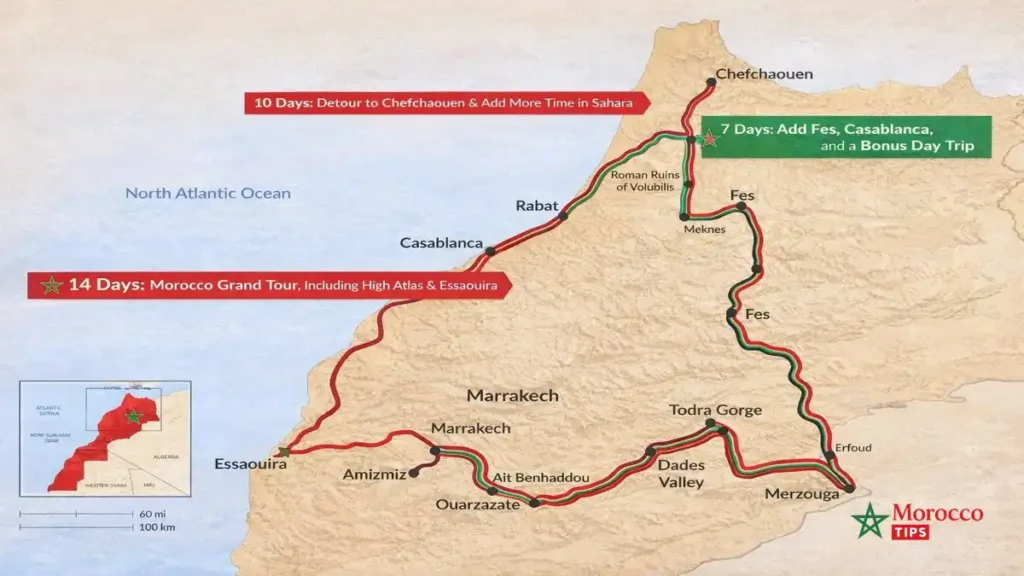
Before Choosing Your Morocco Itinerary, Understand the Distances
This is the part many travelers underestimate.
Morocco is not difficult to travel around, but the country is bigger than it first appears. The High Atlas Mountains divide Marrakech from the desert regions, and places such as Chefchaouen and Tangier are far to the north.
The Sahara also needs time.
Merzouga should not be treated like a quick excursion from Marrakech. The road through the High Atlas, Ait Ben Haddou, Ouarzazate, Dades Valley and Todra Gorge is part of the experience.
That is why I prefer routes that move naturally across Morocco instead of repeatedly returning to the same city.
For example: Marrakech → High Atlas → Sahara → Fes makes much more sense on a short trip than Marrakech → Sahara → Marrakech → Fes.
You avoid unnecessary backtracking and every stage of the journey brings a new landscape.
If transportation is one of the parts you are still trying to understand, read my Morocco Transportation Guide before booking hotels in several different cities.
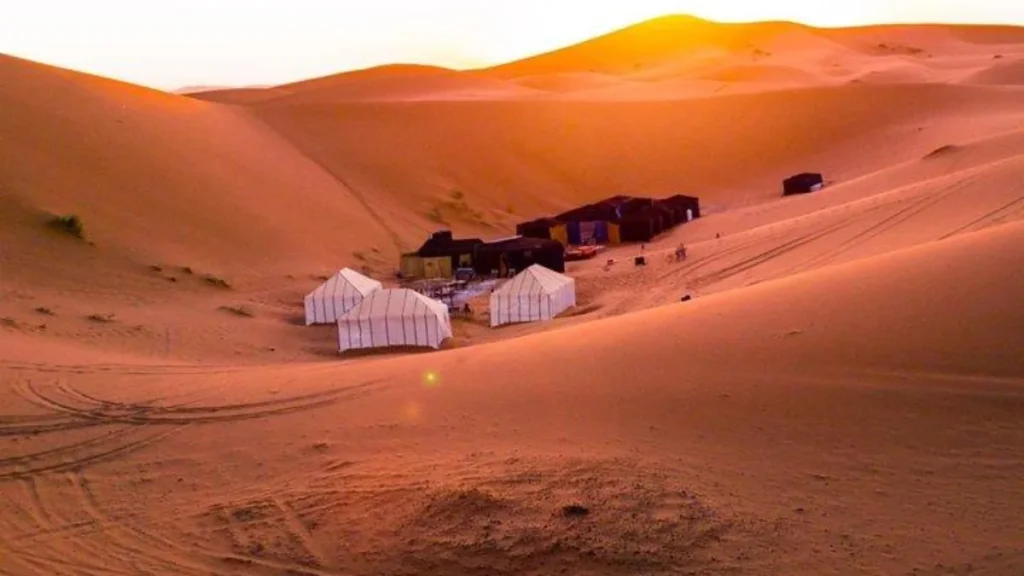
What 7 Days in Morocco Really Gives You
Seven days can work very well, but you need discipline.
I would not try to see Marrakech, Essaouira, Casablanca, Rabat, Chefchaouen, Fes and the Sahara in one week.
Yes, technically you could pass through many of them.
But passing through is not the same as experiencing them.
For a first trip where the Sahara is important, I prefer this route: Marrakech → High Atlas Mountains → Ait Ben Haddou → Dades Valley → Merzouga → Fes.
Ait Ben Haddou is one of the most important historic stops on this route and is recognized by UNESCO as a World Heritage Site.
This gives you four very different sides of Morocco in one journey: the energy and old medina of Marrakech, the mountain landscapes and kasbah country of southern Morocco, the dunes and silence of the Sahara, and the history and traditional craftsmanship of Fes.
The trade-off is pace.
There will be long road days, especially on the journey through the south and when traveling from the Merzouga area toward Fes.
That does not make it a bad itinerary. It simply means you should know what you are choosing.
Choose 7 days if:
You want the major highlights, the Sahara is important to you, and you are comfortable changing hotels and spending time on the road.
Do not choose this route if:
You want late breakfasts, long pool afternoons, several beach days or three nights in every destination.
For the complete route, overnight stops, driving days, accommodation advice and alternatives, use my dedicated 7 Days in Morocco Itinerary.
What Changes When You Have 10 Days in Morocco?
Three extra days may not sound like much.
In Morocco, they make a big difference.
With 10 days, you no longer need to make every destination compete for time.
My preferred route builds naturally from south to north: Marrakech → High Atlas Mountains → Ait Ben Haddou → Dades Valley → Merzouga → Fes → Chefchaouen.
You can spend proper time in Marrakech before leaving.
You can slow the desert section down instead of arriving, riding a camel, sleeping and immediately leaving again.
You can explore Fes with more energy.
And you can continue into the Rif Mountains and finish in Chefchaouen without trying to squeeze the Blue City into an already overloaded week.
This is why I call 10 days the best-balanced Morocco itinerary for most first-time travelers.
There are still some long drives. Morocco does not suddenly become a small country because you add three days.
But the long days are balanced by slower ones.
A desert road day can be followed by a quiet evening. A full medina day can be followed by time sitting in a café in Chefchaouen without feeling that you should already be somewhere else.
Choose 10 days if:
You want the Sahara, Marrakech and Fes but also want enough time to enjoy the places rather than simply reach them.
It is especially good for couples, friends and first-time visitors who want a mixture of culture, scenery, food and adventure.
You can see the complete route in my 10 Days in Morocco Itinerary.
Why 14 Days in Morocco Feels Like a Different Trip
Two weeks does more than allow you to add extra cities.
It allows the trip to breathe.
A good 14-day route can include: Marrakech → High Atlas → Ait Ben Haddou → Dades → Merzouga → Fes → Meknes → Volubilis → Chefchaouen → Rabat → Casablanca → Essaouira → Marrakech.
But the important difference is not the number of names on that list.
It is what happens between them.
You can spend a full day around the Sahara instead of treating the dunes as a hotel stop.
You can give Fes the attention it deserves.
You can reach Chefchaouen and still stay long enough to see what the town feels like after the day visitors leave.
You can visit Rabat without racing through it.
And after mountains, desert roads and busy medinas, you can finish with the Atlantic air and slower pace of Essaouira.
That contrast is one of the things I love most about a two-week journey.
By the end, Morocco does not feel like a collection of tourist attractions. You begin to understand how different the regions really are.
Choose 14 days if:
You have the time and want Morocco to be the main journey rather than a quick highlights trip.
It is also the itinerary I prefer for travelers who dislike rushing, photographers who want better light and slower mornings, and people who want to combine cities, desert and coast.
See my full 14 Days in Morocco Itinerary for the complete day-by-day route.
7 vs 10 vs 14 Days in Morocco: Which Is Best for You?
The right answer depends less on your bucket list and more on the way you like to travel.
If the Sahara Is Your Main Dream
Seven days can be enough.
Build the trip around Marrakech, the High Atlas, Merzouga and Fes instead of trying to include northern Morocco and the Atlantic coast as well.
With 10 days, the Sahara becomes much easier to enjoy slowly.
With 14 days, you can spend additional time around Merzouga and still explore other regions comfortably.
My Merzouga Sahara Desert Travel Guide will help you understand the desert before choosing a camp or route.
If You Hate Long Driving Days
Do not choose your itinerary only by famous landmarks.
Seven days spent around Marrakech, the Atlas Mountains and Essaouira can be a much better holiday for you than seven days trying to cross the country.
Ten or 14 days give you more flexibility to break longer journeys apart.
If You Want Chefchaouen
I prefer adding Chefchaouen when you have at least 10 days, especially if you also want Marrakech and the Sahara.
Chefchaouen sits in northern Morocco. Adding it to a short southern itinerary creates another large transfer.
With 10 days or two weeks, it fits naturally after Fes.
If You Want the Atlantic Coast
Essaouira works beautifully as part of a slower itinerary.
I would add it more comfortably to a two-week route, although travelers who are not interested in the Sahara can easily build a shorter Marrakech-and-Atlantic itinerary.
You can explore the city in more detail in my Essaouira Travel Guide.
If You Are Traveling With Children
With children, I normally remove stops rather than add them.
A route that feels exciting to adults can feel exhausting after several days of packing, long drives and late arrivals.
Give yourself more pool time, earlier hotel arrivals and fewer one-night stays.
My Morocco With Kids guide explains how I adjust Morocco trips for families and different age groups.
Where Should You Start and Finish Your Morocco Trip?
Your flights can completely change whether an itinerary feels easy or unnecessarily complicated.
If possible, do not automatically assume you need to arrive and leave from the same city.
For the classic south-to-north route, arriving in Marrakech and finishing in Fes can save you from driving back across the country.
For longer trips, Casablanca can work well as an arrival or departure point because of its international connections.
Tangier can make sense if your journey focuses on northern Morocco or connects with Spain.
Marrakech works particularly well for southern Morocco, the High Atlas, Ait Ben Haddou and routes toward the Sahara.
Before booking flights, sketch the route first.
Then look at airports.
Not the other way around.
That simple decision can save you an entire travel day.
For the bigger planning picture, see my Plan Your Trip to Morocco guide.
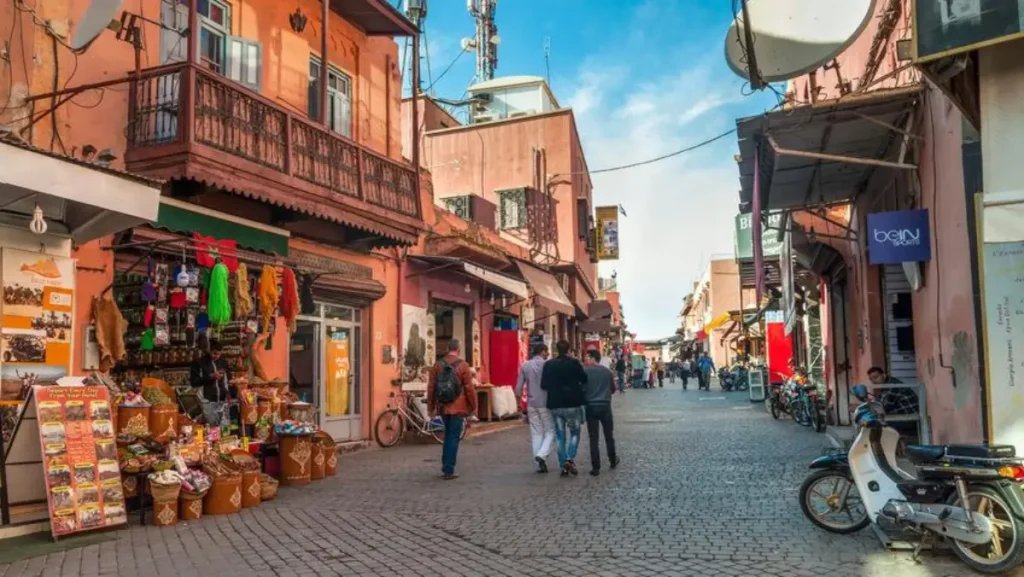
Should You Take Trains, Drive Yourself or Hire a Driver?
There is no single best transport option for every Morocco itinerary.
Trains
Trains work particularly well between many of Morocco’s major northern and central cities.
They can be a comfortable choice for journeys involving places such as Casablanca, Rabat, Tangier, Marrakech and Fes.
But the train network does not take you to places such as Chefchaouen, Essaouira or Merzouga.
For routes, stations, tickets and practical advice, read my Train Travel in Morocco guide.
Renting a Car
A rental car gives you freedom, particularly in the countryside and on routes where you want to stop at viewpoints, villages and smaller destinations.
But driving through unfamiliar mountain roads and finding parking near old medinas is not for everyone.
If you are considering this option, start with my Rent a Car in Morocco and Driving in Morocco guides.
Private Driver
For the Marrakech-to-Sahara-to-Fes route, many travelers prefer a private driver.
You still have the freedom to stop along the road, but you are not spending seven or eight hours concentrating on navigation and traffic.
It is especially useful for families, small groups and travelers who want the journey itself to feel relaxing.
What Is the Best Time of Year for a Morocco Itinerary?
For a route combining Marrakech, the mountains, the Sahara and northern Morocco, spring and autumn are usually the easiest seasons.
Temperatures are generally more comfortable for walking around cities and traveling through the desert regions.
Summer requires more thought.
Marrakech, Fes and the Sahara can become very hot, so I would slow the itinerary down, choose accommodation carefully and consider adding more Atlantic coast time.
Winter can also be beautiful.
Cities are often pleasant during the day and the Sahara can be wonderful, but evenings in the desert can become cold and mountain conditions need more flexibility.
Because the right itinerary changes with the month, I recommend reading my Best Time to Visit Morocco guide before finalizing your route.
The Morocco Itinerary Mistakes I See Most Often
Trying to See the Whole Country in One Week
This is probably the biggest mistake.
A long list of destinations looks impressive before the trip.
By Day 4, it usually feels like luggage, roads and hotel receptions.
Choose fewer places and experience them properly.
Treating the Sahara Like a Day Trip
The journey to the Sahara is part of the experience.
The High Atlas Mountains, Ait Ben Haddou, valleys, kasbahs and southern villages are not obstacles between Marrakech and the dunes.
They are Morocco.
Booking Flights Before Designing the Route
Sometimes travelers save a little money on airfare and then lose an entire day returning to their original airport.
Look at the route and flights together.
Changing Hotels Every Night
Some one-night stops are necessary on a cross-country journey.
But not every night needs to be one.
With 10 or 14 days, use some of your extra time for two-night stays.
Copying Someone Else’s Itinerary Exactly
A couple interested in food and riads should not necessarily follow the same route as a family with small children.
A photographer may want sunrise and sunset access.
Someone who hates driving may be happier combining fewer regions.
A good Morocco itinerary should fit the traveler.
My Recommendation as a Moroccan Tour Guide
If you ask me simply: “Kamal, how many days should I spend in Morocco for my first trip?”
I would say: choose 10 days if you can.
Seven days works, and I have guided many beautiful one-week journeys. But you need to accept a faster rhythm.
Ten days gives you enough time to experience Marrakech, cross the High Atlas Mountains, reach the real Sahara, explore Fes and see Chefchaouen without making the whole trip feel like a race.
If you have 14 days, even better.
Use the extra time to slow down, not simply to add more pins to the map.
Drink tea.
Walk without a plan sometimes.
Stay an extra night in the desert or beside the Atlantic.
Morocco is often at its best in the moments that never appear on an itinerary.
Which Morocco Itinerary Should You Read Next?
If you know your trip length now, continue with the complete route:
One week: 7 Days in Morocco Itinerary – Marrakech to Fes via the Sahara
Best balance: 10 Days in Morocco Itinerary – Marrakech, Sahara, Fes & Chefchaouen
Full journey: 14 Days in Morocco Itinerary – Complete Two-Week Route
And if you are still working out flights, accommodation, money, transport and seasons, start with my Plan Your Trip to Morocco page.
FAQ About Choosing a Morocco Itinerary
Is 7 days enough in Morocco?
Yes. Seven days is enough for a good first trip if you keep the route focused. If the Sahara is important to you, I recommend concentrating on Marrakech, the High Atlas Mountains, Ait Ben Haddou, Dades Valley, Merzouga and Fes rather than trying to add Chefchaouen, Casablanca and Essaouira as well.
Is 10 days enough to see Morocco?
Ten days is one of the best trip lengths for a first visit. You can combine Marrakech, the High Atlas Mountains, the Sahara Desert, Fes and Chefchaouen while maintaining a better balance between sightseeing and travel days.
Are 14 days too long in Morocco?
Not at all. Two weeks gives you enough time to experience several regions without making every day a transfer day. You can combine the desert and imperial cities with northern Morocco and the Atlantic coast while building slower days into the journey.
Is 7 or 10 days better for Morocco?
If your schedule and budget allow it, I recommend 10 days. Seven days can still be excellent, but 10 days gives you more flexibility, more time in important destinations and a better chance to enjoy the Sahara and northern Morocco without rushing.
Is 10 or 14 days better for Morocco?
Choose 10 days if you mainly want the classic highlights. Choose 14 days if you also want the Atlantic coast, additional imperial cities or simply a slower travel rhythm.
Can I visit Marrakech, Fes and the Sahara in one week?
Yes. A route from Marrakech through the High Atlas Mountains and Merzouga to Fes is one of the most logical ways to do it. The trip includes some long road days, so it is better for travelers who are comfortable moving frequently.
Can I add Chefchaouen to a 7-day Morocco itinerary?
You can, but I usually would not if Marrakech and the Sahara are also priorities. Chefchaouen is in northern Morocco, and adding it creates additional travel. It fits much more naturally into a 10-day or 14-day itinerary after Fes.
Do I need two weeks to see the Sahara?
No. You can include the Sahara in a seven-day itinerary. Having 10 or 14 days simply gives you more time to enjoy the desert instead of treating it as a quick overnight stop.
What is the best Morocco itinerary for first-time visitors?
For most first-time visitors, I prefer a route that begins in Marrakech, crosses the High Atlas Mountains to the Sahara, continues north to Fes and then adds Chefchaouen if there is enough time. It gives you a strong combination of medinas, mountains, kasbahs, desert landscapes and local culture without unnecessary backtracking.
How many days do I really need in Morocco?
If you want to experience more than one region, I would aim for at least seven days. Ten days is my preferred balance for a first visit, while 14 days is excellent if you want a broader journey with more time to slow down.