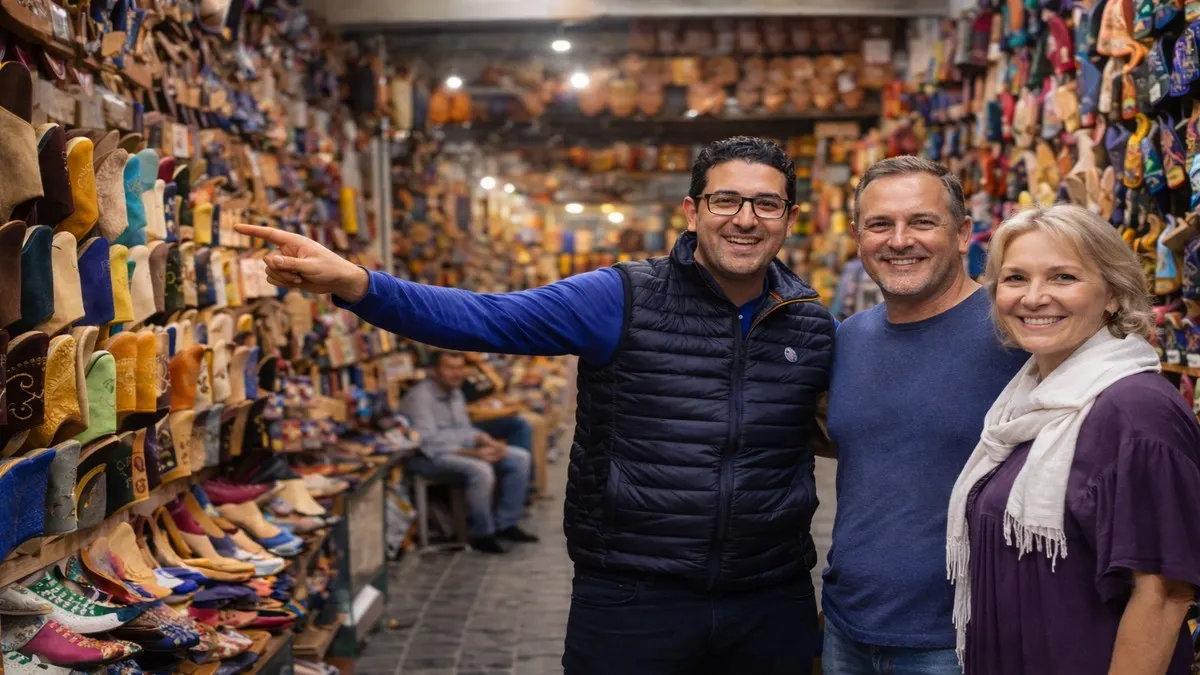
Shopping Tour in Marrakech – How I Actually Guide People in the Souks
Table of Contents
What Is a Shopping Tour in Marrakech and How Does It Work?
This shopping tour in Marrakech is based on real experience in the souks and is written to help you shop with confidence, not pressure. Before we enter the souks, I usually stop for a moment and tell my clients something very simple:
Shopping in Marrakech can be one of the best experiences of your trip, or one of the most stressful ones. The difference is not luck. It’s understanding.
I guide shopping tours in Marrakech as my main job. I don’t do it occasionally, and I don’t follow a fixed script. Every group is different, but the mistakes tourists make are almost always the same. People get excited, they walk fast, they listen to everyone, and after a while they don’t know who to trust anymore. That’s when shopping stops being enjoyable.
This guide is written the same way I guide in real life. Not to sell you things, not to push you into shops, and not to show you “tourist highlights”. My job is to help you understand how the souks really work so you can buy calmly, confidently, and without regrets.
If this is your first time in the city, I always recommend understanding how Marrakech works as a whole before focusing only on shopping. I explain this more clearly in my Plan Your Trip to Morocco and Morocco Travel Guide, which helps travelers arrive with the right mindset.
How Marrakech Souks Work (What First-Time Visitors Should Know)
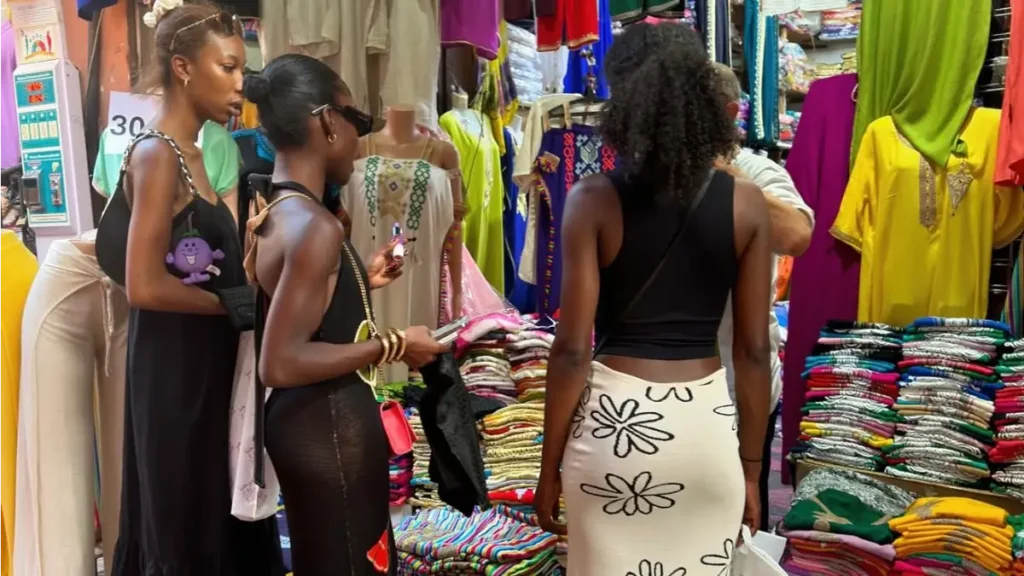
A shopping tour in Marrakech is not about being taken from shop to shop, but about understanding how the souks work so you can buy calmly and make the right decisions.
The souks are not a market made for tourists. They are working places. People earn their daily living there. Some shops depend on one sale a day, others on many small ones. This is important to understand because it explains a lot of the behavior you see.
When you enter the medina near Jemaa el-Fnaa, everything feels intense. Many shops, many voices, many people offering help. This area is busy because it’s the main entrance. Vendors here expect tourists who are walking without a plan. Prices are higher, and conversations are short.
If you go deeper inside, the atmosphere changes. Streets get narrower. Shops become smaller. You see fewer signs in English. Some vendors don’t even speak much English at all. This is usually a good sign, not a bad one.
Shopping is only one part of the experience. The way you move through the medina, handle directions, and plan your days matters just as much, which I also cover in my Things to do in Marrakech guide.
Want a Stress-Free Shopping Experience in the Souks?
Explore the Marrakech souks with a **private local guide** who knows hidden spots, artisan workshops, and smart bargaining tips.
Book the Private Marrakech Souks TourI always explain this to my clients because many tourists think louder means better, or bigger means safer. In the souks, it’s often the opposite.
Why Walking Slowly Is Better Than Walking Fast
A lot of visitors think the best way to survive the souks is to walk fast and say “no” to everyone. I understand why people do this, but in practice it creates more stress.
When you walk fast, you look lost. When you look lost, people try to help you sometimes genuinely, sometimes not. When you stop suddenly, vendors assume you’re ready to buy, even if you’re not. This creates pressure.
When I guide a shopping tour, we walk slowly. We stop without buying. We look without touching. I show people how to enter a shop, how to leave a shop, and how to say no politely without creating tension.
Most problems in the souks don’t come from scams. They come from misunderstandings.
How I Choose Where to Go in the Souks
I don’t take people randomly through the medina. I choose streets based on what they want to buy and how comfortable they feel.
We usually start in open areas, then move toward places like Souk Semmarine so travelers can see many products at once and understand the difference between quality levels. This helps them train their eye before spending money.
Later, we move into calmer areas such as Souk El Attarine, where conversations are slower and shopkeepers explain more than they push. This is where people start feeling confident again.
By the time someone buys something, they already understand what they’re paying for. That’s the goal.
What to Buy in Marrakech Souks (Honest Advice From a Local Guide)
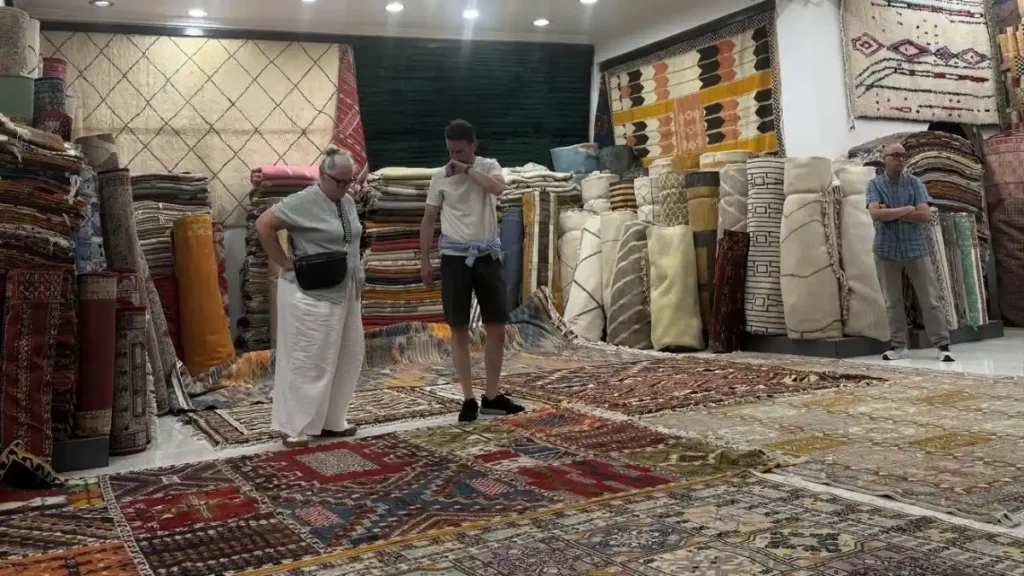
During a shopping tour in Marrakech, I help travelers understand which products are worth their money and which ones are better to skip.When clients ask me, “What should we buy in the souks?”, I never answer quickly. Not because the question is difficult, but because the wrong answer can cost people a lot of money and disappointment.
The truth is simple: not everything in the souks is worth buying, and not everything that looks traditional is well made. Some items are beautiful souvenirs. Others are made fast for tourists and won’t survive the trip home.
My job during a shopping tour is to help people spend their money on things that make sense things they will still like months later, not just on the day they bought them.
Are Moroccan Rugs Worth Buying? What Most Tourists Don’t Know
Moroccan rugs are the item people dream about the most, and also the one people regret buying the most when it’s done wrong.
Before anything else, I always tell my clients one simple thing: a rug is not a souvenir, it’s a decision. You don’t buy it because it looks nice today. You buy it because you can imagine it in your home next year, and the year after.
A real handmade Berber rug takes time. You can feel it immediately when you touch it. It has weight, density, and life in the wool. When you press it with your hand, it comes back slowly. Cheap rugs look colorful, but they feel flat and light. Many of them are made quickly for tourists and sold with the same story again and again.
This is why I don’t stop in random rug shops.
When a client is seriously interested in rugs, I take them to one address I trust for real Berber rugs, not because it’s fancy, but because the work is honest. The rugs there come directly from the Atlas regions, the difference between handmade and factory rugs is explained clearly, and nobody rushes the decision. You sit, you look, you compare, and you take your time.
I like this place because:
- The quality is consistent
- The explanation is clear, not dramatic
- Prices are fair for the work involved
- There is no pressure to buy
Very often, after seeing real quality, clients understand something important: either they truly want a rug, or they realize they don’t need one. Both outcomes are good.
And I say this honestly many times I advise people not to buy a rug at all. If you don’t have the space, if you’re unsure, or if you feel rushed, the best decision is to walk away. A good rug will still be there tomorrow. A bad decision will stay with you for years.
Leather Bags and Shoes – Very Popular, Very Mixed Quality
Leather is everywhere in Marrakech. Bags, belts, shoes, wallets. Some are excellent. Many are not.
One thing I explain clearly: not all leather in the souks is real leather, even if the seller says it is. Some bags are made from pressed leather scraps. They look good at first but crack after a few months.
Good leather smells natural, not chemical. It feels soft but strong. Stitching is clean, not rushed. Zippers are solid, not light.
I also explain price honestly. If a leather bag is very cheap, there is always a reason. Good leather costs money everywhere in the world Marrakech is no exception.
During a shopping tour, I take people only to places where I know the leather quality, not because they give the lowest price, but because clients don’t come back angry later.
Lanterns and Metal Work – Looks Easy, Breaks Easily
Metal lanterns are one of the most common purchases in Marrakech. They photograph well, they look traditional, and they feel light enough to travel with.
Here’s what tourists often don’t know: many lanterns are decorative only. Thin metal, weak wiring, sharp edges inside. They look fine in the shop and become a problem at home.
When clients want lanterns, I slow things down. I show them how to check thickness, how to look inside, how to ask the right questions. Sometimes I tell them honestly: “This one is nice for decoration, but not for daily use.”
People appreciate this honesty. It saves them money and frustration.
Argan Oil – The Most Confusing Product
Argan oil is probably the most confusing item for visitors. Everyone says they sell the best one. Prices vary wildly. Stories are repeated.
I tell my clients one thing very clearly: real argan oil is not cheap, and it doesn’t need a long story to prove it’s real.
Real argan oil has a light, nutty smell. It absorbs slowly. It is not watery. If someone tries to convince you with pressure or dramatic explanations, I become careful.
This is one product where I often recommend buying less, not more. A small bottle of real oil is better than a big bottle of something mixed.
Is a Moroccan Kaftan Worth Buying in Marrakech?
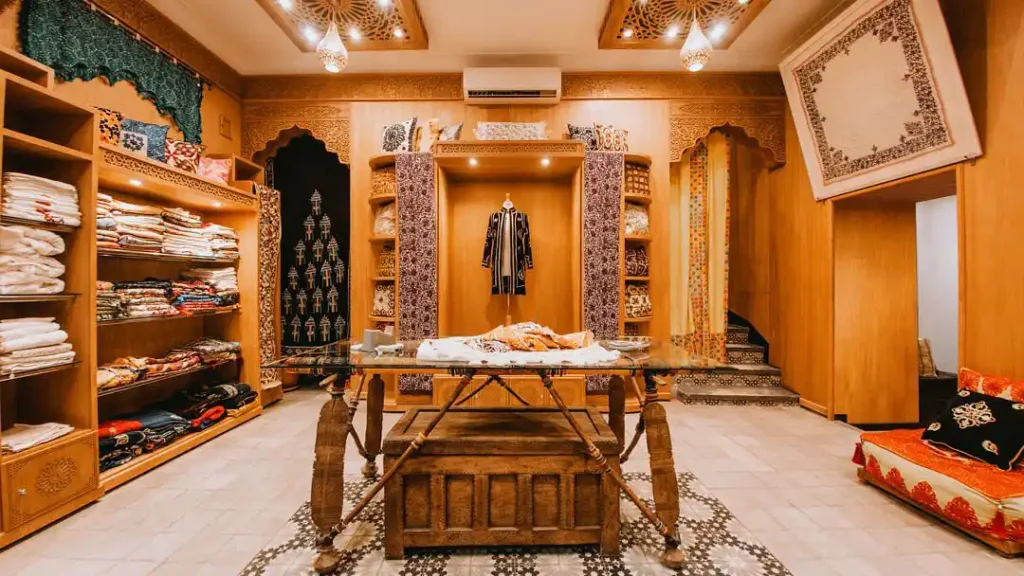
Moroccan kaftans are one of the most elegant things you’ll see in the souks, and also one of the most misunderstood.
Many visitors think every kaftan they see is traditional, handmade, and special. In reality, there is a big difference between a real Moroccan kaftan, a simple takchita, and dresses made quickly for tourists.
A true kaftan is about work, not just fabric. You see it in the stitching, the sfifa (decorative trim), the buttons, and the way the fabric falls. Handmade details take time, and time always shows in the price. If a kaftan looks very elaborate but costs very little, something doesn’t add up.
When clients ask me if they should buy a kaftan, I ask them first why.
Is it for a special occasion?
Is it something they will actually wear again?
Or is it just because it looks beautiful in the shop?
There is no wrong answer, but the intention matters.
During my shopping tours, I avoid places that push kaftans aggressively or rush fittings. A good kaftan shop lets you touch the fabric, explains the difference between machine and hand work, and gives honest advice about what suits your body and your use. If a shop says “this is all handmade” without explaining anything, I become careful.
Another thing tourists don’t expect: many good kaftans are made to order. Measurements are taken, details are discussed, and the piece is finished properly. This takes time sometimes days but the result is completely different from buying something off the rack.
And I’m honest with my clients about this too:
If you’re short on time, or if you don’t usually wear long dresses at home, a kaftan might not be the best purchase. It’s better to buy something you’ll truly use than something that stays in the closet.
When a kaftan is chosen for the right reason, it becomes one of the most meaningful things people take home from Marrakech.
Ceramics and Pottery – Easy to Love, Easy to Break
Moroccan ceramics are beautiful and practical, but not all are hand-painted. Many are stamped using molds, especially the cheaper ones.
I show clients how to look closely at patterns, how to see brush strokes, and how to tap the plate gently to hear the sound. Hand-painted pieces feel different.
I also talk about transport. If you travel light, ceramics may not be the best idea. Some shops ship internationally, but shipping costs must be clear and written.
How Bargaining Works in Marrakech Souks (Prices, Tips, and Mistakes)
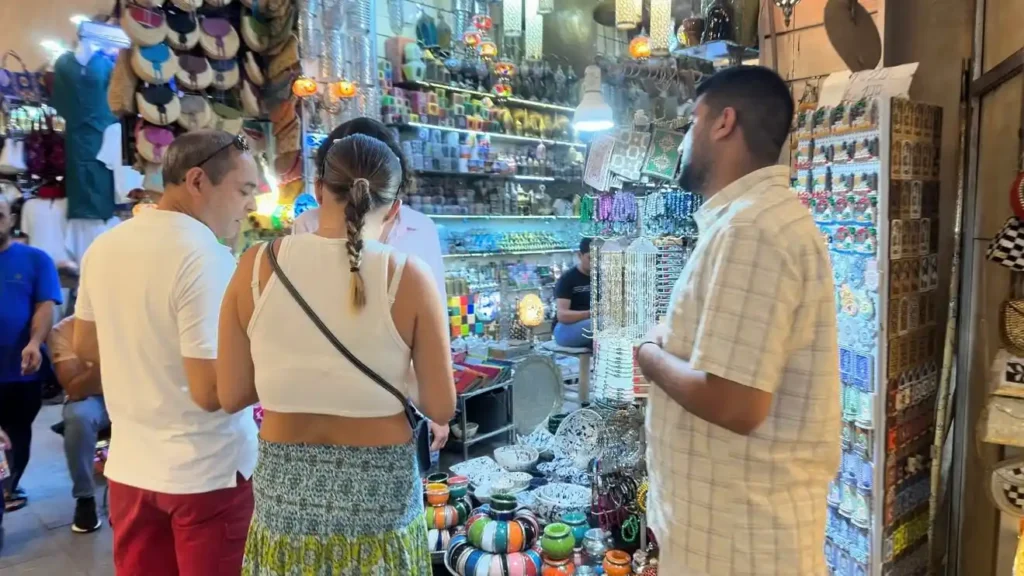
This is the part people worry about the most before coming to Marrakech. Prices. Bargaining. Am I paying too much? Am I being cheated?
I always tell my clients something very honest at the beginning: there is no single “correct price” in the souks. Prices depend on quality, location, time, demand, and how the conversation happens. What matters is not paying the lowest possible price it’s paying a price that makes sense for what you are buying.
Most bad experiences happen because people bargain without understanding what they’re bargaining for.
When you see a price that feels high, it doesn’t automatically mean it’s a scam. Sometimes it’s just a starting point. Other times it reflects real work and materials. The problem is that tourists often don’t know which is which, so everything feels suspicious.That’s where stress begins.
Why Prices Are Never Written
Many visitors ask me why prices are not displayed clearly in the souks. The reason is simple: the souks are not a supermarket. They work on conversation, not labels.
The seller watches how interested you are, how much time you take, and how you react. This doesn’t mean they are trying to trick you. It means the price is flexible depending on the situation. Locals do the same thing they just understand the game better.
I explain this early so people stop taking it personally. It’s business, not an attack.
How Bargaining Goes Wrong for Tourists
Most tourists make one of two mistakes.
The first mistake is agreeing too fast. If you accept the first or second price without discussion, you almost always pay more than necessary. The seller assumes you are inexperienced, not generous.
The second mistake is bargaining too aggressively. People sometimes offer prices that are unrealistic or joke about it. This closes the conversation. The seller stops taking you seriously, and the experience becomes uncomfortable.
I always remind clients: bargaining is not a fight. It’s a discussion.
How I Approach Bargaining During a Shopping Tour
When I guide a shopping tour, I don’t shout prices or argue. I let the conversation stay calm.
First, we take time. We look. We ask questions. We show interest without commitment. This already changes the price.
Then, if the client likes something, I help them make an offer that is reasonable, not insulting. If the seller refuses, we don’t push immediately. We pause. Very often, the price comes down naturally.
Sometimes I tell clients to walk away not as a trick, but because it’s genuinely not the right moment. If the seller calls us back, fine. If not, that’s also fine. There are many shops in Marrakech.
I also explain something important: not every price needs to be pushed to the limit. If the quality is good, the explanation is honest, and the price feels fair, saving a few euros is not worth ruining the experience.
What a “Good Deal” Really Means
A good deal in Marrakech is not about winning. It’s about balance.
The client feels happy with what they bought.
The seller feels respected for their work.
Nobody feels pressured or regretful.
When this balance exists, shopping becomes enjoyable. When it doesn’t, even cheap items feel expensive later.
That’s why, at the end of a shopping tour, clients usually say the same thing:
“I didn’t feel stressed today.” That sentence is more important to me than any price.
Common Shopping Scams in Marrakech Souks and How to Avoid Them
Most people imagine scams in Marrakech as something aggressive or obvious. In reality, the situations that cause problems are usually quiet and friendly. That’s why they work.
I tell my clients this clearly: most people in the souks are working honestly. But there are situations where tourists lose control of the experience without realizing it. My job during a shopping tour is to spot these moments early and stop them before they become uncomfortable.
Many of these situations are not aggressive scams, but quiet tricks that rely on confusion or politeness. I explain more common examples in my guide on Morocco travel scams and tourist traps, especially for first-time visitors.
“My Friend Has a Shop” – The Most Common Situation
This happens every day.
Someone starts walking next to you, smiling, asking where you’re from. They seem friendly, relaxed, helpful. Then, slowly, the sentence comes:
“My friend has a shop. Just look. No obligation.”
I always stop this immediately.
Sometimes this person is not a guide, not a seller, not even connected to the shop. If you enter, you are suddenly expected to buy something, or at least give a tip. If you don’t, the mood changes.
I explain to my clients that real help in the souks does not need to follow you. If someone truly wants to help, they give directions and leave.
Being Taken Somewhere You Didn’t Choose
Another situation I watch carefully is when people are gently redirected. You think you’re going straight, but suddenly you’re turning left, then right, then stopping in front of a shop you didn’t choose.
This often happens when tourists look unsure or stop too long at crossroads. It’s not always malicious, but it puts you in a position where it’s harder to say no.
During my tours, I always walk slightly ahead. Not to control, but to keep direction clear. When people know where they’re going, these situations disappear.
Fake Cooperatives and Emotional Stories
Some shops present themselves as cooperatives, especially for argan oil, rugs, or women’s crafts. Some cooperatives are real. Others are just shops using the word because it sounds ethical.
I tell my clients not to decide based on the story alone. A real cooperative explains how it works, where the products come from, and why prices are set the way they are. They don’t rush you. They don’t pressure you emotionally.
If a story feels designed to make you feel guilty instead of informed, I become careful.
Pressure Tea and Endless Sitting
Tea is part of Moroccan culture, but it can also be used to slow you down too much.
Sometimes people sit, tea is poured, products are brought one by one, and suddenly an hour has passed. You feel tired, polite, and obligated. This is when people buy things they didn’t really want.
I tell my clients something very simple: you can enjoy tea and still say no. Politeness does not mean obligation. If you feel tired or unsure, it’s time to stand up.
During tours, I manage timing so tea stays a pleasure, not a trap.
The Quiet Pressure to “Decide Now”
One of the most effective tricks is subtle urgency:
“This is the last one.”
“Tomorrow the price is higher.”
“Someone else is coming to see it.”
Sometimes this is true. Often it’s not.
I always remind clients: Marrakech is full of shops. Very few things are truly unique. If something is meant for you, it will still make sense after you leave the shop.
A good decision survives a pause.
Why People Feel Relieved on a Guided Shopping Tour
At the end of shopping tours, people often tell me they didn’t realize how tense they were before. They thought feeling stressed was normal.
It’s not.
Shopping in Marrakech should feel curious, calm, and interesting not defensive. Most problems don’t come from bad intentions, but from lack of understanding.
When you know what to expect, these situations lose their power.
Is a Guided Shopping Tour in Marrakech Worth It?
I’m very honest with people about this, even when they contact me directly. Not everyone needs a shopping tour in Marrakech, and I don’t pretend otherwise.
Some travelers are very confident, they like figuring things out alone, they don’t mind making small mistakes, and they enjoy the chaos. If that’s you, walking the souks on your own can be fun.
But for many people, a guided shopping tour changes the experience completely not because I show secret places, but because I remove stress.
A shopping tour is worth it if you:
- Feel unsure about prices and quality
- Don’t want to waste time in shops that sell poor products
- Want explanations, not pressure
- Are short on time
- Want to buy something meaningful, not random
Some travelers prefer booking through a platform with reviews and flexible cancellation. If that’s you, you can check available Marrakech shopping tours on Viator, which gives you a clear idea of prices and tour styles before booking.
If you prefer something more personal, you can also contact me directly on WhatsApp I guide private shopping tours myself and adapt the visit to what you actually want to buy without pressure or fixed routes.
What most clients appreciate is not that I bargain for them, but that they don’t feel alone in the process. Someone is there to say, “This is good quality,” or “This one is not worth it,” or simply, “Let’s leave.”That reassurance makes a big difference.
Who I Recommend a Shopping Tour For
I often recommend a shopping tour for:
- First-time visitors to Marrakech
- Couples who want a relaxed experience
- Families who don’t want stress with kids
- Travelers interested in rugs, leather, or kaftans
- People who had a bad shopping experience before
For these travelers, a guided tour turns the souks from something overwhelming into something enjoyable.
Who Might Not Need One
I also tell people honestly when a shopping tour may not be necessary.
If you:
- Are staying long in Marrakech
- Don’t plan to buy anything specific
- Enjoy exploring slowly without guidance
- Don’t mind overpaying a little sometimes
Then walking alone can still be fine.
A guide doesn’t replace curiosity. A guide just gives structure.
What a Good Shopping Tour Should Feel Like
A good shopping tour should never feel rushed or forced. You shouldn’t feel like you are following a fixed route or a fixed list of shops.
When I guide, the tour adapts to the client. Some people want explanations. Others want silence. Some want to buy many things. Others buy nothing. All of that is normal.
At the end, the best sign of a good tour is simple:
You feel calm. You feel informed. And you feel happy with your decisions.
Practical Tips for Shopping in Marrakech Souks
Before I take clients into the souks, I always give a few simple tips. They’re not complicated, but they make a big difference.
First, don’t start shopping the moment you enter the medina. Walk a bit. Let your eyes adjust. Let your mind slow down. When people buy too fast, it’s usually because they’re excited or nervous, not because they found something special.
Second, wear comfortable shoes and carry as little as possible. The souks are not flat, and you’ll walk more than you expect. When people are tired or carrying bags, they make quick decisions just to be done. That’s when mistakes happen.
Third, decide in advance what you’re interested in. You don’t need a strict list, but having an idea helps. When people say “I’ll just see what happens,” they often end up confused. When someone says, “I’m curious about leather” or “I want to look at rugs,” the experience becomes clearer.
Another important thing: cash is still king in the souks. Some shops accept cards, but many don’t, and card prices are often higher. I always advise people to carry a reasonable amount of cash and not pull out large stacks in busy areas.
And finally, this is something I repeat often: you are allowed to leave any shop at any time. You don’t need an excuse. You don’t need to explain. A polite thank you is enough. Shopping should never feel like a trap.
Shopping in Marrakech Souks: Frequently Asked Questions
Is shopping in Marrakech safe?
Yes. Marrakech is generally safe for shopping, especially during the day. Most problems are not about safety, but about pressure or confusion. When you stay calm and aware, shopping is enjoyable.
How much should I bargain?
There is no fixed rule. Bargaining depends on the product, quality, and situation. The goal is not to win, but to reach a price that feels fair to both sides. If the price feels reasonable and the quality is good, don’t overthink it.
Can shops ship items abroad?
Yes, many shops offer international shipping, especially for rugs, ceramics, and furniture. Always agree on the price, shipping cost, delivery time, and responsibility in writing before paying.
Are all “handmade” items really handmade?
No. Many items are partly machine-made or produced quickly for tourists. This doesn’t mean they’re bad, but they shouldn’t be sold as fully handmade. Asking calm, simple questions usually reveals the truth
Is it rude to say no after tea?
No. Tea is hospitality, not a contract. You can enjoy tea, thank the seller, and leave without buying. Politeness goes both ways.
Is this just shopping?
Not at all. It’s a cultural experience + smart shopping.
Book the private tour here
What if I’m a solo traveler?
Solo travelers are welcome, with group pricing available.
Reserve your spot
Final Advice From a Local Shopping Tour Guide
Shopping in Marrakech is not about finding the cheapest price or the rarest object. It’s about understanding where you are, who you’re dealing with, and what you actually want.
The souks are alive. They are noisy, beautiful, confusing, and sometimes exhausting. But when you approach them with patience and clarity, they become one of the most rewarding parts of the city.
After years of guiding shopping tours, I’ve learned that the best purchases are not the ones people talk about the most on the day they buy them they’re the ones people still enjoy when they’re back home.
Whether you explore alone or choose a shopping tour in Marrakech with a local guide, the goal is the same: to shop calmly and enjoy the experience.