Why Morocco Feels Bigger Than It Looks on the Map
What first-time visitors only understand after they arrive
Why Morocco feels bigger than it looks is something most travelers only understand after they arrive and start moving between cities.Most travelers come to Morocco with a clear picture in their mind. They have looked at the map, counted the days, and decided that the distances make sense. From the outside, Morocco looks compact. Cities appear close together. Routes look manageable. The plan feels realistic.
Table of Contents
Table of Contents
What surprises people is not that the plan fails. It often works. What surprises them is how full each day feels once they are inside the country.
After a few days, travelers start to realize that they are not moving through Morocco the way they move through other destinations. Days feel dense. Transfers feel meaningful. Even when they are sitting in a car, they feel like they are already doing something.Many first-time visitors don’t realize why Morocco feels bigger than it looks until they experience the country day by day, moving through cities, roads, and landscapes that demand more time than expected.
This is where the feeling of size comes from.
Morocco does not feel big because of how far places are from each other. It feels big because the space between places is active. When you travel here, you are not passing through empty zones designed only to connect destinations. You are moving through inhabited land, worked land, lived land.
This is something maps cannot show.
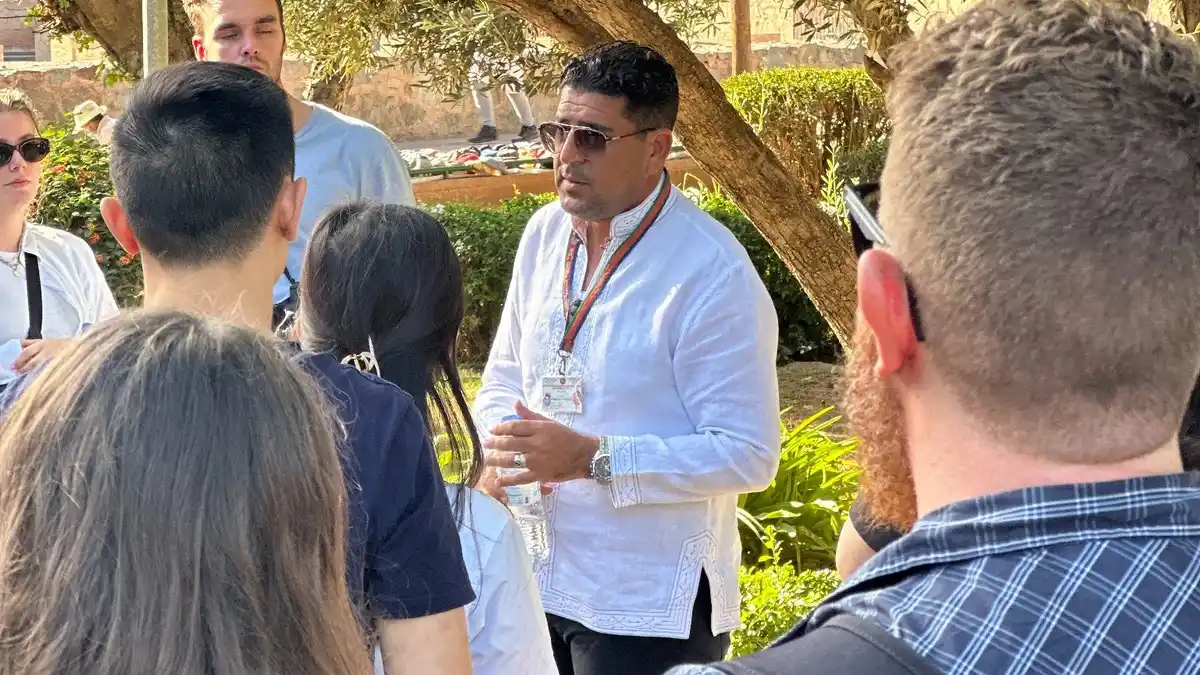
As a local tour guide, I spend a lot of time on the road. I don’t just drive between cities I watch how people react to those drives. I see how their mood changes, how their attention shifts, how their energy rises and falls during the day. This is what teaches you how Morocco really works.
When travelers imagine a three- or four-hour drive, they imagine a neutral block of time. They imagine sitting, resting, maybe sleeping. In Morocco, that almost never happens. Even without stops, your mind stays active. Landscapes change quickly. Villages appear and disappear. You notice people working, walking, waiting. The road itself asks for attention.
By the time you arrive, you feel like you have already experienced part of the country, even if you didn’t leave the vehicle.
This is not tiring in a bad way. But it is consuming. And when you stack several of these days back to back, Morocco begins to feel much larger than expected.
This is why many first-time visitors underestimate how much time they need to truly enjoy each place. They think the challenge is distance. In reality, the challenge is accumulation. Each movement adds weight to the day, and that weight carries over.
That is also why I always tell people who are planning a trip to Morocco that maps should be treated as a rough guide, not a planning tool. The country does not compress neatly into time slots. It expands naturally into the space you give it.
When people allow that space, they don’t feel rushed. They don’t feel behind schedule. They don’t feel like they are constantly catching up with their own plan. When they don’t, they often arrive in beautiful places already tired, already distracted, already thinking about the next move.
This is the quiet reason Morocco feels bigger than expected. Not because it demands effort, but because it refuses to be reduced.
I’ve put all the essentials together in my Morocco Travel Guide, written from a local guide’s point of view, so you know what to expect before you arrive.
Why Morocco Feels Bigger Than It Looks When You Start Traveling
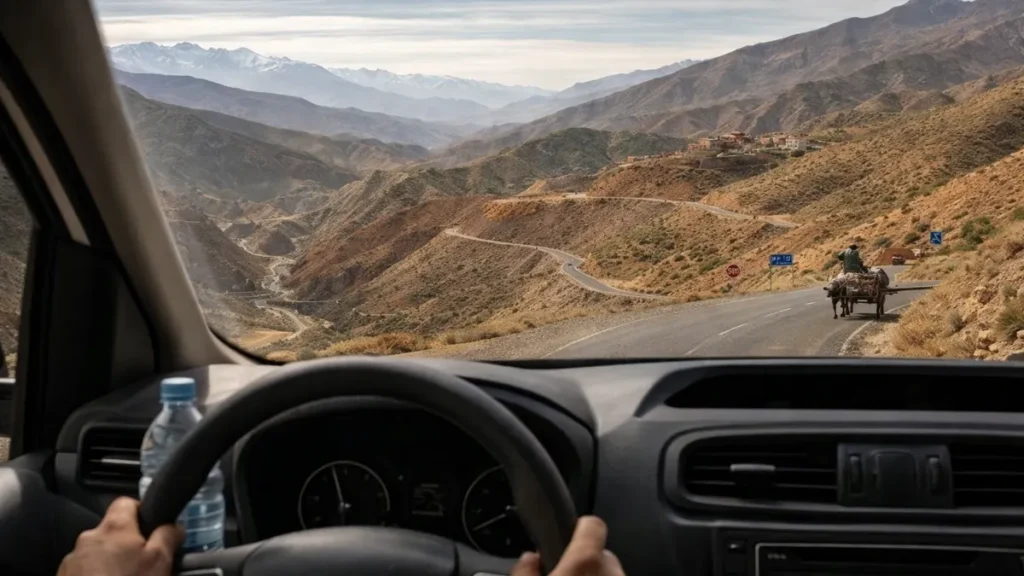
When travelers ask me how long it takes to go from one city to another, they usually want a number. Three hours. Four hours. Six hours. Something clear that they can put into their plan and move on.
I understand that instinct. But after years of guiding and driving across Morocco, I’ve learned that giving only a number is not honest enough.
Because travel time here is not just about arrival. It’s about what happens inside those hours.
Take a very common route: Marrakech to Essaouira. On a map, it looks simple and direct. Most apps show around three hours. And yes, if you leave early, don’t stop, and drive straight through, you can arrive close to that estimate.
But that is not how most people experience this road.
The landscape changes slowly from red earth to open plains. Small towns interrupt the pace. Trucks appear. Goats cross. Coffee stops start to look inviting, even if you didn’t plan them. Travelers look outside, ask questions, want to understand what they’re seeing.
By the time you arrive, it has usually been closer to four hours, sometimes more. Not because something went wrong, but because the road asked for attention.
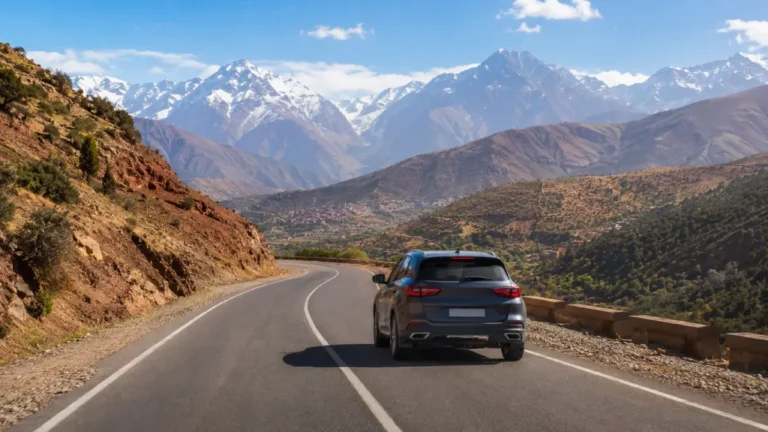
Another example is Marrakech to Aït Ben Haddou. This route crosses the High Atlas Mountains, something many travelers don’t fully imagine until they are inside it. The road climbs, curves, narrows, opens again. Weather can change quickly. Traffic slows naturally in certain sections.
Maps often show around four hours. In real conditions, five hours is much more realistic, especially if you want to stop at viewpoints or arrive without feeling rushed. This is why, as a guide, I never plan anything important immediately after arrival on this route. The journey itself already fills the day.
The same logic applies in the north. Fes to Chefchaouen looks close, and compared to other routes, it is. Still, leaving a large city, crossing hilly terrain, and entering mountain roads adds time that doesn’t show clearly on a screen. What looks like a short transfer often becomes most of the day once you include traffic, breaks, and the natural slowdown of the road.
This is where many itineraries quietly fail.
They assume that travel time is neutral. That you can “use” the rest of the day once you arrive. In Morocco, that assumption doesn’t hold. By the time you reach your destination, you have already given a large part of your attention to the journey.
That’s why I always advise people looking at Morocco itineraries to think in terms of days, not distances. One meaningful transfer is usually enough for one day. Two transfers in a single day almost always feel heavy, even if the kilometers look reasonable.
This also affects costs in ways travelers don’t expect. Longer days on the road mean more fuel, more driver time, sometimes extra nights. People are often surprised when they start calculating Morocco travel costs, because they planned based on distance instead of real movement.
None of this is meant to discourage travel across the country. On the contrary. These roads are part of what makes Morocco memorable. They show you how the country changes, how people live outside cities, how landscapes shift without warning.
But they need to be respected.
When you allow extra time between cities, you arrive present. You enjoy where you are. You don’t feel like you’re constantly adjusting your plan. When you don’t, the country starts to feel demanding not because it is, but because the plan is too tight for the reality on the ground.
This is another reason Morocco feels bigger than expected. The map shows distance. The road delivers experience. And experience always takes more space than numbers suggest.
Why Moroccan Cities Feel Larger the More You Walk Them
When travelers look at Moroccan cities on a map, they often underestimate them. Marrakech doesn’t look very big. Fes looks compact. Even Casablanca, when reduced to lines and blocks, seems easy to understand.
Then they start walking.
What people don’t expect is that Moroccan cities are not experienced horizontally. You don’t just move from one side to another. You move through layers.
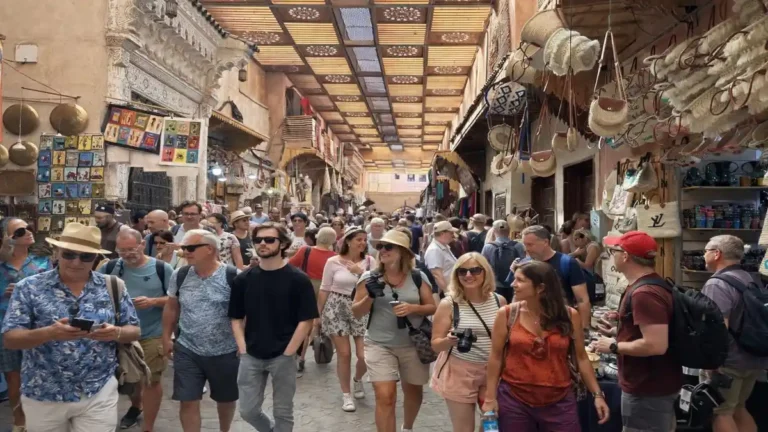
A single neighborhood contains several worlds at the same time. Work happens next to home. Shops open into living space. Streets change character every few steps. You pass from noise to quiet, from open squares to narrow passages, from light to shade, sometimes without realizing it.
This is why a short walk can feel long, even when you are not tired.
You are not just covering distance.
You are crossing functions.
In cities like Marrakech and Fes, the medina is not a single environment. It’s a collection of small zones stitched together. One street sells food. The next sells metal. The next is residential. The next leads to a mosque, then suddenly to a dead end.
For someone used to cities built on grids or clear districts, this creates a strange sensation. You feel like you’ve walked a lot, even if the actual distance is short. Your mind has been switching context constantly.
As a guide, I notice this clearly when I walk with guests. After an hour inside the medina, they often ask how far we’ve gone. When I tell them the distance, they are surprised. It feels longer because each part required attention.
Another reason cities feel bigger is verticality.
In Morocco, especially in old cities, much of life happens behind walls and above eye level. Riads hide courtyards. Workshops sit behind simple doors. Rooftops carry movement you don’t see from the street. Sound travels differently. Smells drift from places you can’t locate.
You are surrounded by activity that you sense but cannot fully see.
This creates a feeling of depth. Not physical size, but presence.
Modern cities guide you with visibility. Moroccan cities guide you with familiarity. Locals know where they are because they recognize patterns, not because they see everything clearly.
Visitors don’t have those references yet.
That’s why cities feel larger at first. Not because they are confusing, but because they don’t reveal themselves all at once. You need time inside them before they start to feel smaller.
This is also why trying to “see everything” inside one city rarely works. You end up moving constantly without absorbing much. The city doesn’t open when you rush it. It opens when you repeat paths, sit in the same café twice, walk the same street again.
After a few days, something interesting happens.
Places that felt far suddenly feel close.
Routes that felt complex become simple.
The city shrinks not on the map, but in your mind.
That’s when people start saying things like:
“Now it makes sense.”
“I feel comfortable walking here.”
“I know where I am.”
Nothing changed in the city.
You did.
This is why Moroccan cities reward staying longer rather than moving faster. A city that feels large on day one can feel intimate on day three if you give it that chance.
Why Seeing More Places Often Leaves You With Less
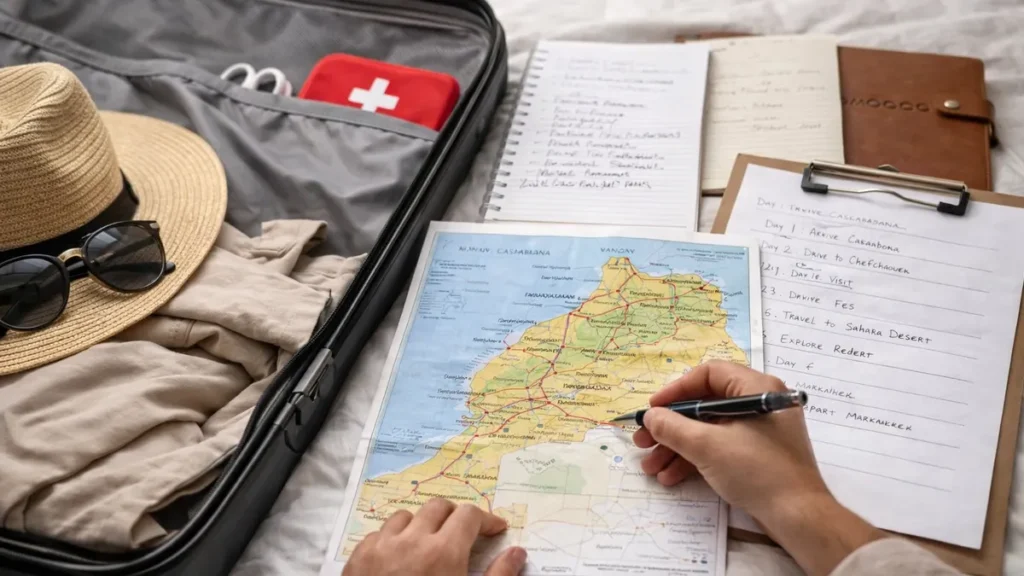
After a trip, when I ask travelers how Morocco felt, the answer is often shaped by one thing: how many places they tried to include.
People who moved every one or two nights usually say the same sentence, even if they enjoyed the trip:
“We saw a lot, but it went very fast.”
People who stayed longer in fewer places say something different:
“It feels like we really know the country.”
This difference has nothing to do with intelligence, curiosity, or travel experience. It comes from how Morocco reacts to movement.
Each city in Morocco carries its own atmosphere. Not just in architecture or history, but in how the day unfolds, how people interact, how the city breathes. When you arrive somewhere new, your attention is fully occupied just by orientation. You learn where you are, how the streets behave, where to sit, where to walk, when things feel comfortable.
That learning takes time.
When travelers move on too quickly, they never reach that point. They collect impressions instead of familiarity. Each city becomes a surface experience, and surfaces all start to resemble each other after a while.
This is why trips with many cities often feel strangely compressed, even though they cover more ground. The mind never settles long enough for a place to leave a deep mark.
As a guide, I see this clearly in the middle of trips. When people change cities too often, conversations shift. They ask fewer questions about where they are and more questions about logistics. The trip becomes about timing, luggage, departures, arrivals.
The country shrinks into a sequence of tasks.
When travelers slow down and stay two or three nights in one place, something else happens. They stop asking where things are. They start asking why things are the way they are. They recognize faces. They return to the same café without thinking about it.
That’s when Morocco expands. Not geographically, but emotionally.
Adding more cities feels productive, but it often reduces depth. You see more names, but understand less context. Morocco is not a destination where highlights replace time. The experience grows through repetition, not accumulation.
This is especially important for first-time visitors. Morocco already offers a lot of sensory input. Moving constantly adds another layer of effort. When that effort stacks, the trip feels dense but shallow.
This doesn’t mean you should limit yourself to one place. It means choosing movement carefully. One transfer, one adjustment, one new environment at a time.
When itineraries respect this, travelers finish their trip feeling like Morocco was generous. When they don’t, the same country can feel demanding.
This is another reason Morocco feels bigger than expected. Not because it requires distance, but because it asks for presence. And presence needs time in one place, not just movement between places.
Why Morocco Feels Short Only After You’ve Left
Something interesting happens to many travelers only after they leave Morocco.
While they are here, days feel full. Sometimes even long. They wake up, move, see, listen, adapt. Each day seems to carry its own weight. They don’t feel like time is flying.But once they are home, the feeling changes.
They look back and say:
“It went so fast.”
“I feel like we just arrived.”
“I wish we had stayed longer.”
This is not nostalgia speaking. It’s how memory works when experiences are dense.
In places where days are repetitive, memory stretches time. In Morocco, days are varied. Each one contains different scenes, different sounds, different interactions. When the brain stores those memories, it compresses them. Many moments become one strong impression instead of a long sequence.
That compression makes the trip feel short in hindsight, even if it was busy or long.
I notice this especially when travelers message me weeks later. They don’t talk about schedules or routes anymore. They talk about small moments. A conversation. A street at night. A meal they didn’t expect to enjoy so much. A view from a window.
Those moments stay because they were lived fully, not rushed.
This is another reason Morocco feels bigger while you’re here and smaller after you leave. During the trip, your attention is stretched outward. After the trip, your memory pulls everything inward.Understanding this helps travelers plan better next time.
Instead of trying to fill every day, they leave room for moments to settle. Instead of chasing more places, they give meaning to fewer ones. They don’t try to fight the feeling of fullness during the trip, because they know that later, it will turn into clarity.
Morocco doesn’t leave you with a long list of facts.
It leaves you with a strong internal image.
And that image doesn’t measure time in days or kilometers. It measures time in feeling.
That’s why Morocco often feels short only after you leave because while you were here, you were fully inside it.
How to Plan a Morocco Trip That Actually Feels Finished
When someone asks me to help plan a trip to Morocco, I don’t start by asking how many cities they want to see. I start by asking something much simpler: how they want to feel at the end of the trip.
Some people want to feel rested.
Some want to feel inspired.
Some want to feel like they really understood the country.
Once you know that, the rest becomes easier.
The biggest mistake I see is planning Morocco as if it were neutral space. As if you can move, arrive, visit, and move again without cost. In reality, every move here asks something from you attention, curiosity, adaptation. That’s not bad, but it must be respected.
So when I plan, I think in blocks, not points. I look at where movement naturally fits and where it doesn’t. I leave space not for problems, but for life. For roads that invite stopping. For cities that take time to enter. For evenings that shouldn’t be rushed because they are often the best part of the day.
A trip feels complete when days have shape. When there is a beginning, a middle, and an end that doesn’t feel forced. When arrival days are lighter. When long drives are not followed by heavy schedules. When at least a few mornings are left open, without a plan attached to them.
Morocco gives back what you allow it to give. If you plan tightly, it gives intensity. If you plan with space, it gives depth.
This is why two people can follow similar routes and leave with very different impressions. One feels like the trip was demanding. The other feels like it was generous. The difference is rarely the destination. It’s how much pressure the plan applied.
A complete trip here is not about covering ground. It’s about allowing places to settle before moving on. It’s about accepting that some days are meant for moving and others for staying. It’s about understanding that what you don’t schedule is often what stays with you longest.
When Morocco is planned this way, it doesn’t feel big or small. It feels balanced. You don’t leave thinking about what you missed. You leave feeling like the country showed you what it could, within the time you gave it.
That’s when travelers say something I hear often, and always with the same tone:
We didn’t see everything… but it feels enough.And that’s exactly how Morocco is meant to be experienced.
FAQs About Traveling Morocco
Why does Morocco feel bigger than other countries of similar size?
Morocco feels bigger because travel here is not just about covering distance. The space between places is active. Roads pass through lived landscapes, cities require attention, and even short transfers ask for energy. When movement itself becomes part of the experience, the country feels larger than what a map suggests.
How many cities should I realistically include in one Morocco trip?
For a first trip, fewer cities usually lead to a better experience. Two to four main stops over a week or ten days is often enough. Adding more locations doesn’t always mean seeing more; it often means spending more time moving and less time actually settling into places.
Are driving distances in Morocco misleading?
The distances themselves are accurate, but the time experience is often underestimated. Mountain roads, small towns, natural slowdowns, and stops make journeys longer in real life. This is why local guides always add extra time between cities when planning routes.
Is it better to travel Morocco fast or slow?
Morocco is much more rewarding when traveled at a slower pace. Staying multiple nights in one place allows cities and regions to open up naturally. Fast travel works logistically, but it often feels compressed and tiring compared to staying longer in fewer locations.
Why do Moroccan cities feel large even when they’re not?
Cities like Marrakech and Fes are dense rather than wide. You move through layers of daily life, not just streets. Short walks can feel long because your attention is constantly shifting between environments. Over time, as you become familiar, the city starts to feel smaller and easier.
How much extra time should I allow between destinations?
As a general rule, adding 30 to 90 minutes beyond map estimates makes travel much more comfortable. This buffer allows for natural slowdowns and helps you arrive without feeling rushed or mentally full before exploring the destination.
Does travel time affect the cost of a Morocco trip?
Yes. Longer days on the road affect fuel use, driver time, accommodation nights, and sometimes meal planning. This is why trips planned tightly on distance alone often end up costing more than expected.
Why does Morocco feel short only after the trip ends?
During the trip, days feel full because each one contains many different moments. Afterward, memory compresses those experiences into strong impressions. This makes the trip feel like it passed quickly, even if it was long and active.
What’s the best way to plan Morocco so it feels complete?
Plan with space, not pressure. Balance travel days with stay days. Avoid stacking long drives back to back. Leave room for mornings or evenings without fixed plans. Morocco feels complete when you allow places time to settle instead of trying to fit everything in.
Practical Note on Where You Stay
One thing travelers often underestimate in Morocco is how much accommodation location affects the experience. Staying in the right area can save time, reduce unnecessary movement, and make each city feel much easier to navigate.
In places like Marrakech, Fes, and Essaouira, a well-located stay means less back-and-forth, calmer mornings, and evenings that do not feel rushed. This matters even more when you are trying to slow the trip down and avoid packing too much into each day.
When comparing riads and hotels, I always recommend looking closely at location, real traveler reviews, and cancellation flexibility before booking. A good stay should match the pace of your trip, not only your budget.
Disclosure: If you book through some links on this site, I may earn a small commission at no extra cost to you. It helps support this site and allows me to keep sharing honest local advice.
Final Words From Kamal, Your Local Guide
Morocco is a country that reveals itself slowly, often when you stop trying to measure it.
Some things here don’t show their meaning immediately. A street you walk past without noticing becomes familiar a few days later. A place that felt ordinary at first returns to you in memory long after you leave. These moments don’t announce themselves they settle quietly.
Traveling here teaches patience without forcing it. You begin to notice small details, not because you are looking for them, but because you are finally still enough to see them. That shift happens naturally when you allow time to work instead of managing every minute.
What stays with you after Morocco is rarely a single landmark or perfect plan. It’s a sense of connection to moments that didn’t try to impress you. A simple walk. A pause. A shared silence.If you leave with that, you’ve understood more than any guidebook can explain.Understanding why Morocco feels bigger than it looks helps travelers plan with confidence, avoid rushed itineraries, and enjoy the country without feeling pressured by distance.