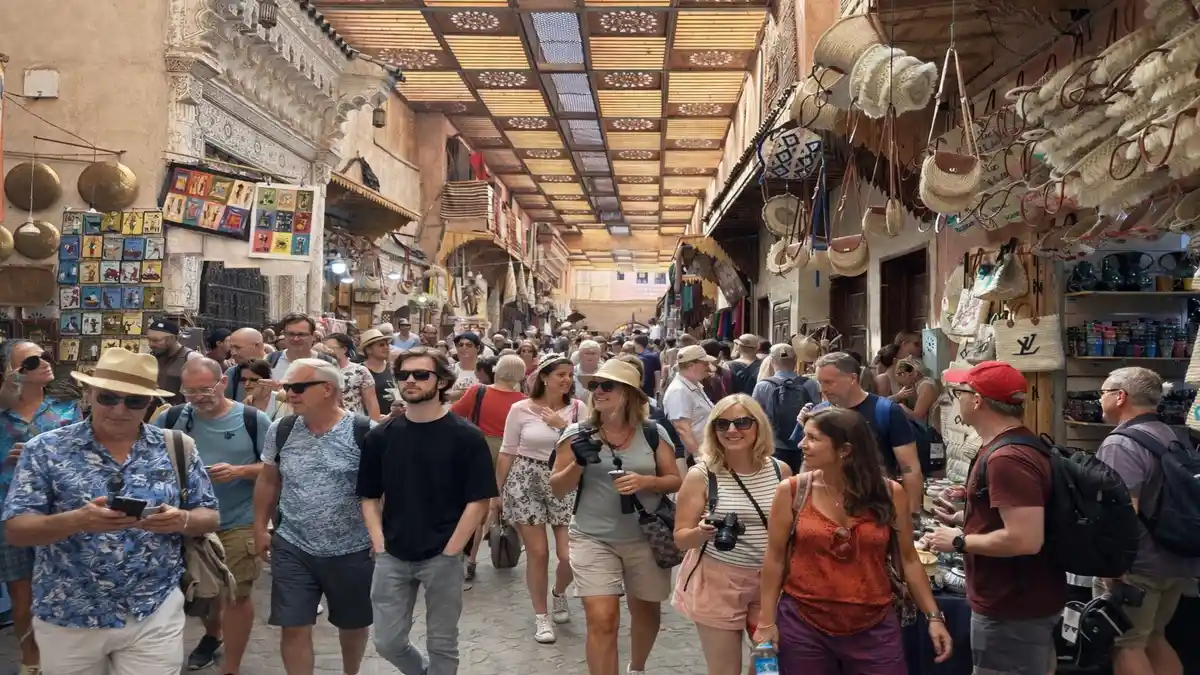
Marrakech Souks Guide: How the Souks Really Work
Before You Visit: How the Marrakech Souks Really Work.
The souks are part of the Marrakech Medina. This is where people earn their living, not a place created mainly for visitors. Many families depend on daily work here. Some shops have been in the same hands for generations. Others open only when there is work to do.
This is why the souks do not feel organized in a clear way. Streets were not planned to be easy to follow. They developed slowly around homes, mosques, small workshops, and storage spaces. Over time, people doing similar work stayed close to each other because it was practical.
When you walk away from Jemaa el-Fna, the space changes. Streets become narrower. Movement slows. Sounds feel closer. This is not something unusual here. It is simply how the medina is built.
Many visitors expect shops to work like shops at home. In the souks, this is not always the case. A place can look closed but still be active inside. A man may be working quietly without speaking to anyone. A shop may open late or close early depending on the day.
Talking and working happen at the same time. People stop to greet neighbors, drink tea, or pray. Business does not follow strict schedules. This can feel confusing if you are used to fixed hours and clear rules.
Another thing that surprises visitors is how often people speak to them. Not every greeting is an invitation to buy something. In the medina, speaking to strangers is common. Some people talk out of habit. Some are curious. Some hope to sell. Learning to tell the difference takes time.
The biggest mistake visitors make is trying to understand everything immediately. They try to follow a route, worry about going the wrong way, or feel pressure to buy something quickly. This creates stress that is not necessary.
I always advise travelers to walk through the souks first without any goal. Don’t look for a specific shop. Don’t worry about prices. Just observe how people move, how work is done, and how different each street feels.
Once you accept that the souks are not designed to be clear or fast, they become much easier to handle. You stop fighting the place and start moving through it naturally.
If this is your first time visiting the medina, it helps to understand how daily life works in Marrakech before walking into the souks. I explain this in more detail in my Marrakech Travel Guide.
Table of Contents
Table of Contents
How the Marrakech Souks Are Organized – Why Similar Shops Are Together
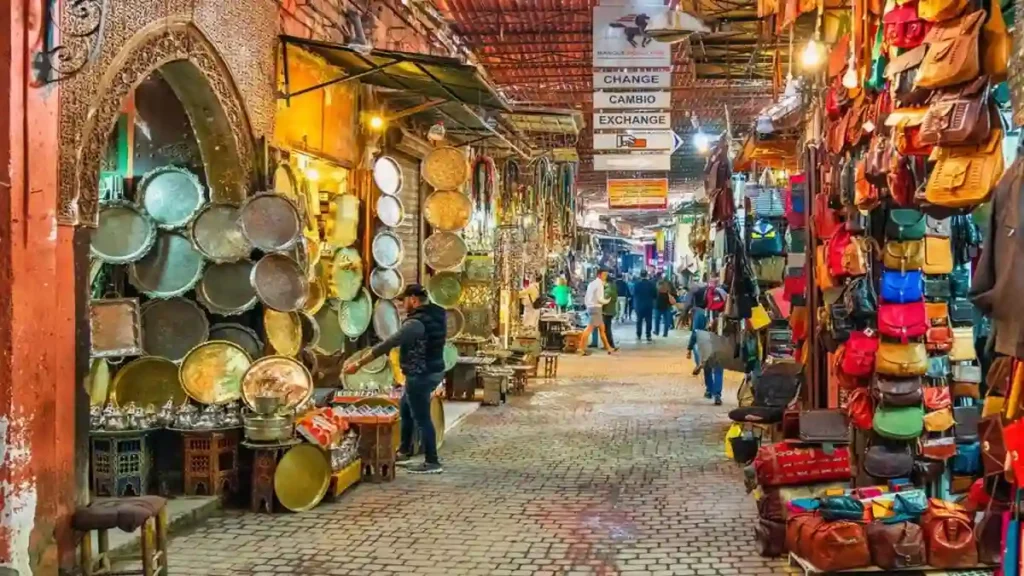
One of the first questions travelers ask me is why the Marrakech souks feel confusing at the beginning, but suddenly start to make sense after some time. The answer is simple: the souks follow logic, but not the kind most visitors are used to.
The organization of the souks comes from work, not design.
Inside the Marrakech Medina, people doing the same job stayed close to each other because it was practical. Leather workers needed suppliers nearby. Dyers needed water and space. Metalworkers needed room for tools and noise. Over time, these areas became known for one activity, and that structure stayed.
This is why you often walk through one street filled with leather goods, then suddenly find another where almost every shop sells lanterns or metalwork. It is not coincidence. It is habit built over many years. If you plan to buy a piece, my Marrakech lantern-buying guide explains what to check before paying and how to plan packing.
When you enter the souks from Jemaa el-Fna, you usually arrive in Souk Semmarine. This is the widest and busiest part, and it acts like a main road. Many visitors spend most of their time here without realizing it. It is lively, full of color, and easy to walk, which is why prices are often higher. If you are browsing clothing around Semmarine and the nearby kissaria, my Marrakech kaftan-buying guide explains how to compare styles, check the fit and discuss alterations.
As you move away from this main path, streets become narrower and more specialized. This is where the real organization becomes clear.
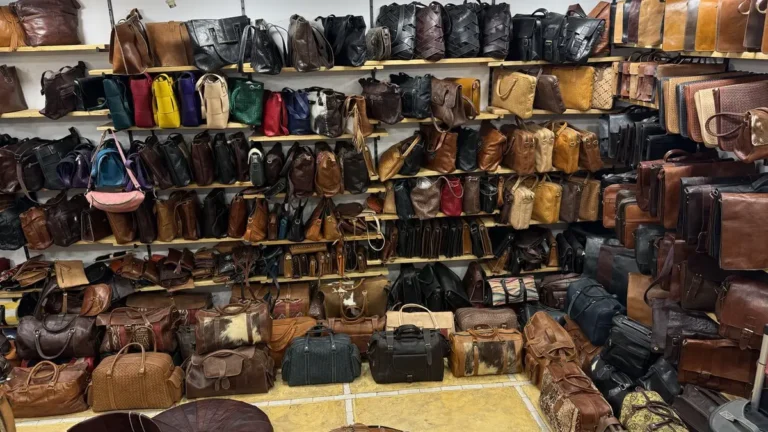
In Souk Smata, for example, leather slippers and simple leather goods dominate the street. Shops here often look similar because they sell similar items. The difference is not in the display but in the quality of leather, stitching, and finishing. To notice that difference, you need time and patience. If you are choosing a bag, my Marrakech leather-buying guide explains how to check straps, stitching, lining and closures before paying.
Further inside, Souk Sebbaghine, known as the dyers’ area, feels different again. Wool is dyed here, sometimes hung above the street. This area is closely connected to textile and rug sellers nearby. Many rugs sold in this part of the souks come directly from families who work with wool, not from large stores.
Then there is Souk Ableuh, where food products take over. Olives, spices, dried fruits, herbs, and daily ingredients are sold here. Locals pass through quickly, knowing exactly where to stop. This area feels less focused on visitors and more on daily needs.
What many travelers don’t realize is that not every door leads to a shop. Some spaces are storage rooms. Some are workshops without a sales area. Some belong to families who live above or behind the work space. This is why you sometimes see similar doors but very different activity inside.
Another important thing to understand is that prices and quality often improve as you go deeper. The shops closest to main entrances see the most visitors and adjust their prices accordingly. Further inside, sellers rely more on regular clients and word of mouth. Conversations change. Pressure is lower.
The organization of the souks also explains why it’s easy to feel lost. Streets don’t connect in straight lines. They bend, narrow, widen, and split without warning. This was never meant to confuse anyone. It is simply how the medina grew around work, not tourism.
Once you understand that the souks are arranged by activity, not direction, walking through them becomes easier. You stop worrying about where you are and start noticing what kind of work surrounds you. That awareness is what helps you navigate without a map.
Many of these areas are easier to understand when explored on foot as part of a relaxed walk through the old city. You can see how this fits into a typical visit in my Things to Do in Marrakech guide.
This is usually the moment when travelers stop asking “Where am I?” and start asking better questions like “Why are all these shops here?” That’s when the souks begin to feel understandable.
What You Will See in the Marrakech Souks
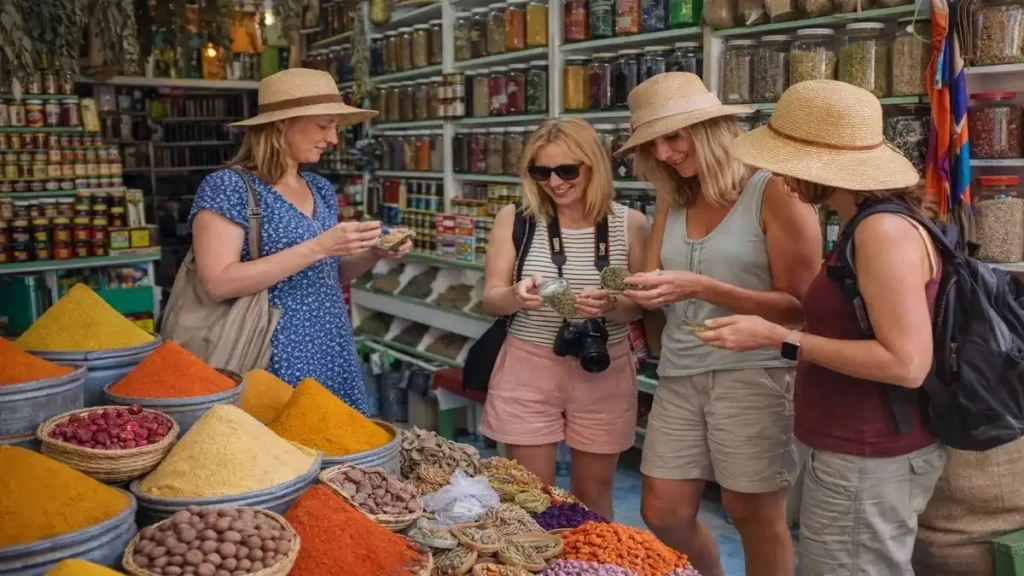
Walking through the Marrakech souks, you will see a huge range of Moroccan crafts and everyday goods: lanterns, leather bags, rugs, spices, ceramics, tea glasses, baskets, jewelry, textiles, slippers and small decorative items. If pottery is on your list, my Marrakech ceramics-buying guide explains what to inspect and how to plan packing before paying. For rings, bracelets and necklaces, my Marrakech silver-jewelry buying guide covers Souk Siyyaghin and the questions to ask about materials before paying. If spices are on your list, my Marrakech spice-buying guide explains what to choose, how to compare prices by weight and what to check before taking purchases home.
What makes the souks interesting is not only what is for sale, but how the work is organized. Some products are made inside the medina, some come from workshops elsewhere in Marrakech, and others arrive from rural areas and different regions of Morocco. You will also see a mix of handmade, partly handmade and factory-produced items.
The best way to experience the souks is to observe first. Look at how materials differ, how workshops are arranged and how similar products change from one street to another. This is where you begin to understand the souks as a working part of the medina rather than simply a shopping area.
If you are specifically trying to decide what souvenirs are worth buying, realistic price ranges and which Moroccan cities are best for different crafts, read my complete What to Buy in Morocco guide.
Considering a rug for your home? Read my guide to whether Moroccan rugs are worth buying before deciding.
If Moroccan rugs are your main interest, start with my guide to buying Moroccan rugs in Marrakech for prices, quality, bargaining and shipping. If you are deciding which shops to visit, see my guide to where to buy rugs in Marrakech for three places I personally recommend.
Prices and Bargaining in the Marrakech Souks
Prices in the Marrakech souks are often flexible, especially for non-food items and handmade goods. There is no single fixed-price system across the medina, and the same type of product can cost more or less depending on quality, location, workmanship and the shop itself.
Bargaining is normal in many traditional shops, but it should feel like a calm conversation, not a fight. You can ask the price, make a reasonable counteroffer and walk away politely if the price does not feel right.
The most important thing is not trying to get the lowest possible number. Take time to compare similar items, understand what you are buying and decide whether the quality and price make sense together.
If you want a deeper explanation of how bargaining works during a guided shopping experience, including common mistakes and how I approach price discussions with clients, read my Shopping Tour in Marrakech guide.
If you are mainly looking for realistic price ranges for rugs, leather, ceramics, slippers, argan products and other souvenirs, see my What to Buy in Morocco guide. For argan products, my Marrakech argan-oil buying guide explains cosmetic versus culinary oil, label checks and comparing the price for the same quantity.
Getting Around the Souks: Directions, Getting Lost, and Help
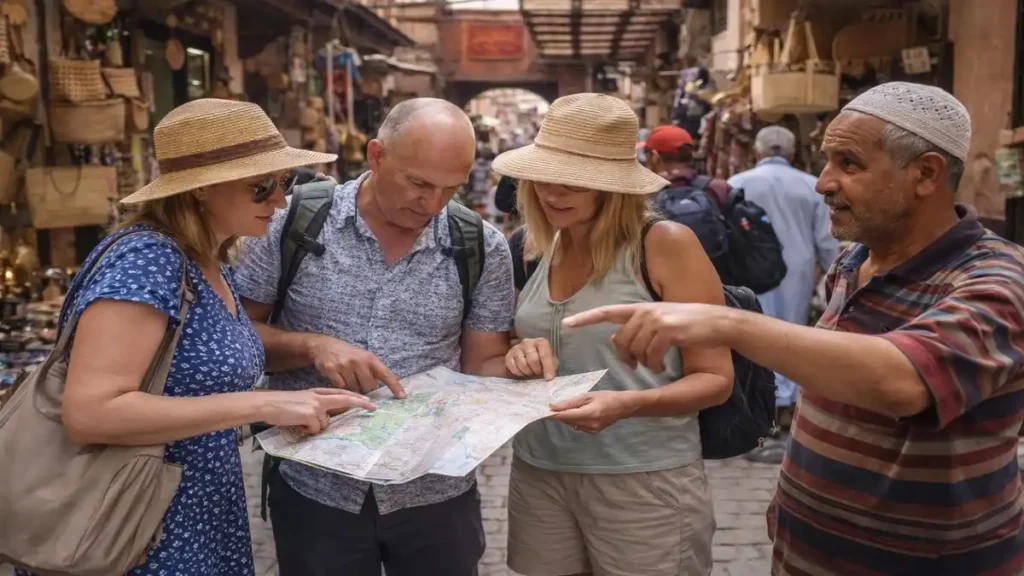
Getting lost in the Marrakech souks is very common, even for people who have already been there once or twice. The streets are not laid out in a straight or logical way, and they were never meant to guide visitors from one point to another. They exist to connect workspaces, homes, and small neighborhoods inside the Marrakech Medina.
Because of this, many visitors feel unsure about where they are going and worry about taking a wrong turn. In reality, there is no real danger in getting lost. Most paths eventually lead back to a main street or to areas close to Jemaa el-Fna. The key is to stay calm and walk at a normal pace.
Directions inside the souks work differently than outside the medina. Street names are rarely used in daily conversation. Locals recognize places by nearby mosques, fountains, or well-known shops. This is why asking for directions does not always give clear results. Two people can describe the same place in completely different ways.
Unwanted help is something many travelers experience. Some people offer directions without being asked. Others start walking with you and expect a tip later. Not everyone has bad intentions, but not every offer of help is necessary.
If you do not want assistance, a simple and polite “La shukran” is enough. There is no need to explain or stop walking. Most people will understand and move on. Being firm but respectful usually ends the conversation quickly.
If you do want help, it is better to ask someone directly rather than accept random offers. Shopkeepers who are busy working or older locals sitting nearby often give clearer directions without expecting anything in return. If someone does help you personally and walks with you, a small tip is considered polite.
If you want to understand how the medina is laid out before exploring on your own, my Morocco Travel Guide explains how old cities work and what to expect.
Another thing to be aware of is movement inside the souks. Small motorbikes and handcarts pass through narrow streets, and people often call out to warn others. Stepping to the side and staying aware of your surroundings is usually enough to avoid problems.
Best Time to Visit the Marrakech Souks
The time you choose to visit the souks changes the experience more than most people expect. The same street can feel completely different depending on the hour and the season.
In the morning, the souks are calmer. Many shopkeepers are opening their spaces, cleaning, arranging goods, and starting work. This is a good time to walk slowly, observe artisans at work, and explore without feeling rushed. Conversations tend to be easier, and pressure to buy is usually lower. For visitors who want to understand how things work, mornings are often the most comfortable.
Around midday, especially in warmer months, the souks become busier and more tiring. Streets fill up, movement slows, and the heat builds up between the walls. Some workshops close for a break, while others stay open. This is when visitors often feel overwhelmed, not because anything is wrong, but because the environment is more intense.
Late afternoon is when the souks become lively again. Shops reopen fully, light changes inside the narrow streets, and activity increases. This time is popular with visitors because the atmosphere feels active but not rushed. It is also when many people choose to shop, which means streets close to main paths can feel crowded.
Evenings are different. Some areas quiet down, especially those focused on daily goods. Others stay open later, mainly near Jemaa el-Fna, where foot traffic continues into the night. The souks never close all at once. Activity fades gradually from one area to another.
If you’re visiting with children, this Marrakech with kids guide explains the best times to explore the souks and how to avoid overwhelm.
Fridays deserve special mention. Friday is an important prayer day, and some shops close temporarily around midday. This is normal and should not be seen as a problem. Planning your visit around this helps avoid confusion.
Seasons also matter. In summer, visiting earlier in the day is easier because of the heat. In cooler months, afternoons are usually pleasant and comfortable. There is no single “perfect” time, but choosing a moment that matches your energy level makes a big difference.
Exploring the Marrakech Souks With or Without a Local Guide
Many travelers ask whether they should visit the Marrakech souks on their own or with a local guide. There is no single correct answer. It depends on what kind of experience you want and how comfortable you feel walking through the medina.
Visiting the souks alone can be enjoyable if you like wandering, observing, and taking your time without a plan. You can move freely, stop where you want, and leave whenever you feel tired. For some people, this sense of independence is part of the experience.
However, visiting with a local guide offers something different.
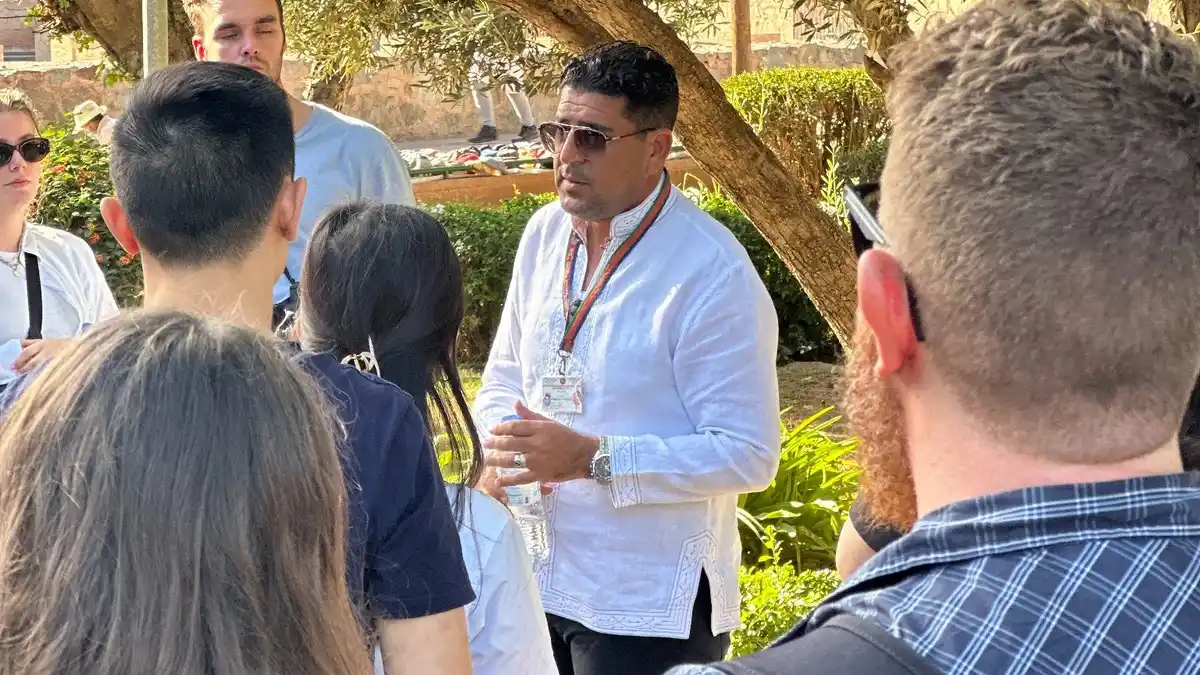
With a guide, you don’t just walk through busy streets. You understand why certain areas exist, how crafts are made, and what separates quality from decoration. You are shown workshops that are easy to miss, places where people are actually working, not just selling. You also avoid many common mistakes, especially when it comes to prices, materials, and pressure to buy.
Another important difference is comfort. Many visitors feel more relaxed knowing someone familiar with the medina is walking with them. There is less stress about directions, less unwanted attention, and more time to focus on learning and enjoying the experience.
When I guide people through the souks, the goal is not shopping. The goal is understanding. Buying comes later, only if and when someone feels ready. There is no obligation to purchase anything. Some people buy a lot. Others buy nothing. Both are completely fine.
For travelers who want a clear introduction to the souks, a guided visit is often the easiest way to start. After that, many feel confident enough to return on their own with a better sense of direction and awareness.
Ready to Experience the Marrakech Souks the Right Way?
If you want to explore the souks without stress, avoid tourist traps, and understand how things really work, a guided experience can make a big difference.
Want to explore with me? My private Marrakech shopping tour is tailored to your interests and walking pace. See the tour details, how I help with quality and bargaining, and how to request availability for your date.
You can also contact me directly on WhatsApp. Send your date, group size and shopping interests so we can discuss the route and total price. There is no obligation to buy anything.
FAQs About the Marrakech Souks
Are the Marrakech souks safe for tourists?
Yes. The Marrakech souks are generally safe, even for first-time visitors. They are busy and sometimes noisy, but serious problems are rare. Like any crowded place, you should keep an eye on your belongings and stay aware of your surroundings. Most issues visitors face come from confusion, not danger.
Is it easy to get lost in the Marrakech souks?
Getting lost is very common, and it’s not a problem. The souks are part of the Marrakech Medina, which was never designed with straight streets or clear directions. Most paths eventually lead back to a main area or toward Jemaa el-Fna. Staying calm and walking at a normal pace is usually enough.
Do I have to bargain in the souks?
Bargaining is normal in many traditional Marrakech souks, especially when prices are not clearly marked. There is no universal percentage you should always negotiate. Compare similar items, stay friendly and agree only to a price you are comfortable paying. For a deeper explanation, see my Shopping Tour in Marrakech guide.
What are the best things to buy in the Marrakech souks?
Popular items include rugs, leather goods, ceramics, lanterns, spices, jewelry, babouche slippers and traditional hammam products. Marrakech is excellent for variety, but the best purchase depends on quality, price and what you actually want to take home. For a full breakdown of the best souvenirs, realistic price ranges and where to buy different Moroccan crafts, see my What to Buy in Morocco guide.
Are prices in the souks fixed?
No. Many traditional souk shops use flexible pricing, although some boutiques and fixed-price shops clearly display their prices. What you pay can vary with the product, quality, craftsmanship and shop. If you want typical price ranges for Moroccan souvenirs, see my What to Buy in Morocco guide.
Should I visit the souks with a local guide?
That depends on your comfort level. Exploring alone is fine if you enjoy wandering and learning slowly. Visiting with a local guide can help you understand how the souks work, avoid common frustrations, and find workshops and areas you might miss on your own especially on your first visit.
What is the best time of day to visit the souks?
Mornings are calmer and easier to explore. Late afternoons are lively and popular with visitors. Midday, especially in summer, can feel tiring because of crowds and heat. Choosing a time that matches your energy level makes a big difference.
Do shopkeepers expect you to buy if they offer tea?
No. Tea is a sign of hospitality, not a contract. You are always free to thank them for their time and leave without buying anything.
Some links on this page may be affiliate links. If you use them to book a tour, I may earn a small commission at no extra cost to you.
If you are still planning your trip, my Best Time to Visit Morocco and Plan Your Trip to Morocco guides can also help you prepare more clearly.
Final Thoughts From a Local Guide
The Marrakech souks are not a place to rush through or try to control. They are part of daily life in the medina, shaped by work, habit, and long-standing traditions. Once visitors accept that, the experience becomes much easier and much more enjoyable.
You do not need to see every street or buy anything to understand the souks. Some of the best moments come from simply walking, watching how people work, and noticing how different each area feels. The more time you give yourself, the more comfortable the place becomes.
Some travelers prefer to explore alone, learning slowly and returning more than once. Others feel more comfortable starting with a local guide, especially on a first visit. Both approaches are valid. What matters is choosing the one that helps you feel relaxed and confident.
If you decide to explore with a guide, the goal should never be pressure or shopping. It should be understanding the place, avoiding common frustrations, and enjoying the experience without stress.
Whether you walk through the souks for one hour or come back several times during your stay, they will leave an impression. Not because of what you buy, but because of how the medina works and the people who keep it alive.
That is the Marrakech I want visitors to remember.